
Primary question: Should a precision die-cut double sided PET tape use a PET film liner or a paper liner?
Direct answer: Start with PET film for tight registration, small parts or automated placement; trial glassine or polycoated paper when the drawing and press permit it. Approve the liner only after a production converting run.
Technical note: figures and test-method references in this guide are for preliminary selection only. Final performance depends on the exact construction, thickness, substrate, application and test method; request the report for the proposed grade before approval.
The liner on a double sided PET tape is part of the converting specification, not packaging to discard. If the job needs narrow registration tolerances, clean matrix removal and automated placement, start the trial with a PET film liner. For wider parts or less demanding geometry, glassine or polycoated kraft paper may convert adequately and should not be ruled out just because the job uses a die.
Start with PET film for tight registration, small parts or automated placement; trial glassine or polycoated paper when the drawing and press permit it. Approve the liner only after a production converting run. The choice must be made against the actual press, die, part drawing and storage conditions. A PET carrier inside the tape and a PET release liner outside it do different jobs: the carrier remains in the bond; the liner supports the adhesive through cutting and is removed at application. Confusing the two produces an RFQ that cannot control converting yield.
Start with the cut and the application method
A converter needs to know whether the press will cut through the tape but leave the liner intact, how the waste matrix will be lifted, and whether an operator or a pick-and-place head will remove each part. The liner must survive that sequence while releasing the finished part at the right moment. If it tears during matrix stripping or stretches enough to move the part, a nominally good adhesive construction becomes scrap.
For high-precision kiss cuts, PET film is the first liner candidate. tesa’s liner guide associates PET liners with high-precision die cuts and lists dimensional stability, thickness tolerance and kiss-cut capability. The 3M thin bonding selection guide also describes polyester liners as suitable for rotary die cutting, with moisture stability and transparency for visual inspection. These are material-selection signals, not a guarantee that any PET liner will run on a particular press.
Paper still has a place in die cutting
The assumption that a paper liner cannot be die cut does not survive the supplier evidence. Glassine and polycoated paper can be die cut; compare curl after storage, registration and stripping on the production press. tesa lists glassine and PE-coated paper as die-cuttable. 3M lists densified kraft or glassine for rotary die cutting and polycoated kraft for flat-bed cutting. The actual paper grade, coating and die setup matter more than a paper-versus-film label.
Where humidity or storage curl has disrupted registration, plain paper deserves closer scrutiny. 3M distinguishes the moisture stability of polyester and polycoated kraft from densified kraft or glassine; tesa likewise identifies PE-coated paper as the humidity-resistant paper option. A converter should compare the condition of the roll at the press after normal storage, not only at dispatch. A polycoated paper liner can be a sensible intermediate trial when the existing glassine curls but film is not otherwise required.
For a wide, simple part picked by hand, a paper liner may be entirely workable. For a small adhesive window with tight spacing and automated transfer, the added stability of film is easier to justify. Those are starting hypotheses; the press trial decides.
Specify release behavior as well as liner material
The liner must stay with the web during unwinding and matrix stripping, yet let the cut part transfer during application. Name the coating sides, retained liner and intended release behavior for unwind, matrix strip and application. tesa notes that release coatings can be set for easier or harder unwinding, especially where automated application runs at speed. Material name alone therefore cannot close the specification.
Ask for the liner construction, coating sides and intended release behavior. If the tape has two liners, name which side the converter strips first and which remains on the finished part. Also state whether visual inspection through a clear liner is useful. The 3M guide identifies transparency as an advantage of polyester liners, but transparency has value only if the inspection station uses it.
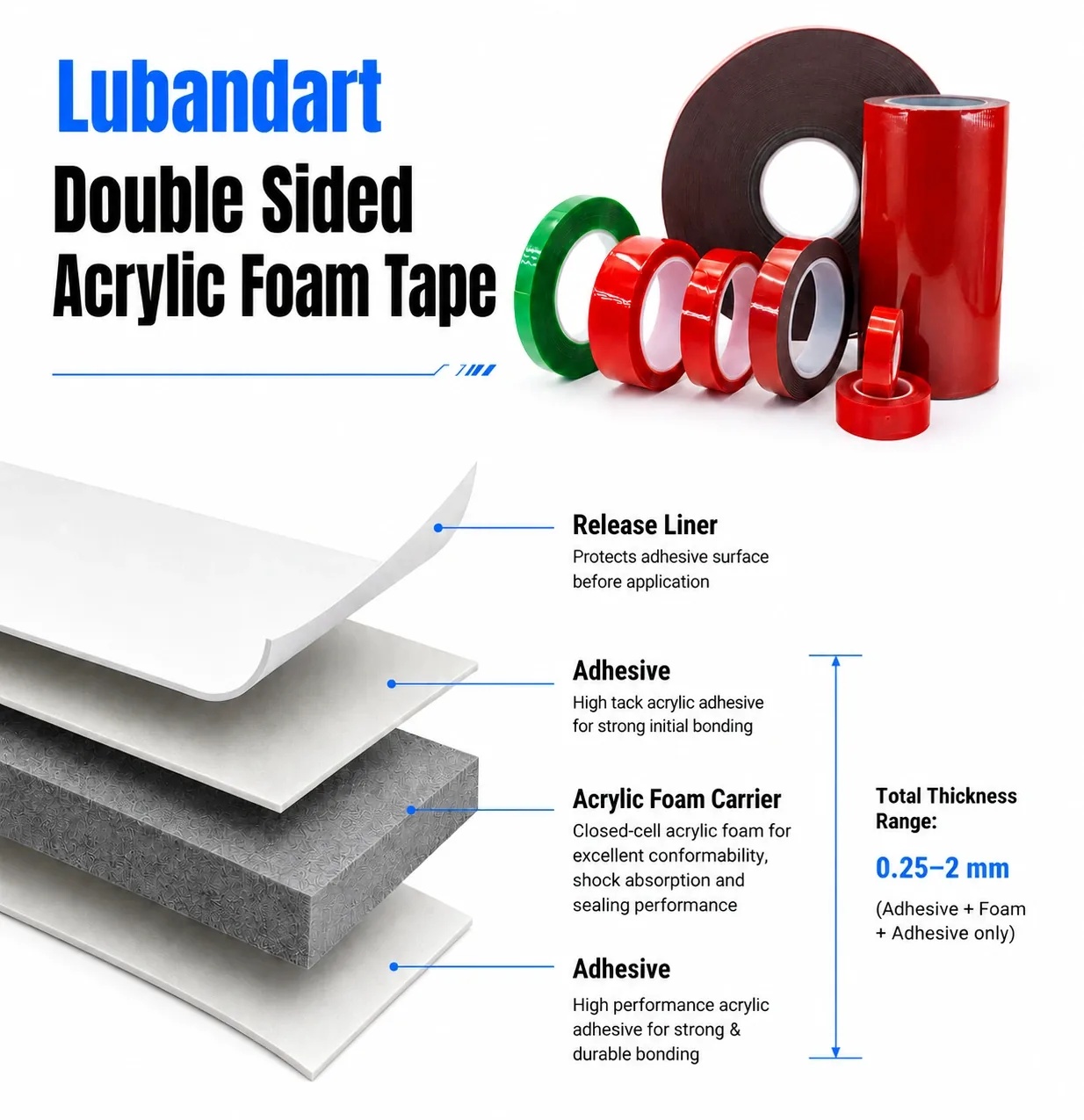
Keep the tape carrier separate in the drawing. The carrier remains in the bond; the liner supports cutting and is removed at application. A thin PET carrier can help the tape retain shape during slitting and die cutting, as 3M notes for a PET-carrier construction, but it does not replace the release liner’s job of supporting the web and controlling release. LubandArt’s double sided PET tape page lists both paper and film liner options and finished die-cut parts. That confirms available configuration categories, not a validated liner grade for your die.
Run a converting trial that can reject the wrong choice
Use the production drawing, actual press speed, die and winding direction. Compare at least one film and one paper construction if both are credible for the part. Record registration at the start and end of the roll, liner damage after kiss cutting, matrix stripping continuity, part retention during indexing and release at the application head. Repeat after the storage conditions the shipment will actually see. The pass limits must come from the buyer’s drawing and process; no universal registration or release-force number can be inferred from a generic liner category.
Change the liner while keeping the adhesive and carrier fixed in the first round. Otherwise a cleaner edge could come from a different adhesive rather than from the liner. If the liner passes the press but the part will not bond to its substrate, that is a separate adhesive qualification problem.
Put the converting constraints in the RFQ
Send the tape construction, part drawing, cut method, die type, web width, winding direction, storage conditions and removal method. State whether the finished part stays on a roll or is supplied as sheets. Ask the supplier to identify the proposed liner material and coating, which side remains after converting, and a sample format that can run on the production press. For a finished die-cut PET part, the quote should cover the liner and delivery format as explicitly as the adhesive thickness.
The decision is practical: specify PET film when precision, stable web handling or inspection demands it; keep a paper option when the geometry and process allow it. Approve the combination only after a converting run shows the part can be cut, stripped, carried and released without avoidable scrap.
Frequently Asked Questions
Can glassine paper be rotary die cut?
Yes. Manufacturer guidance lists glassine as rotary die-cuttable, but its moisture stability differs from film; confirm registration after the storage conditions your rolls will see.
Does a PET tape carrier mean the release liner is PET?
No. The carrier remains in the finished bond while the liner is removed. Specify both materials separately on the drawing and RFQ.
What proves a liner works for automated placement?
A production-speed trial should show continuous matrix stripping, part retention through indexing and clean release at the application head using the actual die and drawing.
Send the part drawing, press and die details, storage conditions and required delivery format to request a liner-specific converting sample.
Request a quote · [email protected] · WhatsApp +86 180 6469 2463
Need this construction for a production run?
Get a quote