
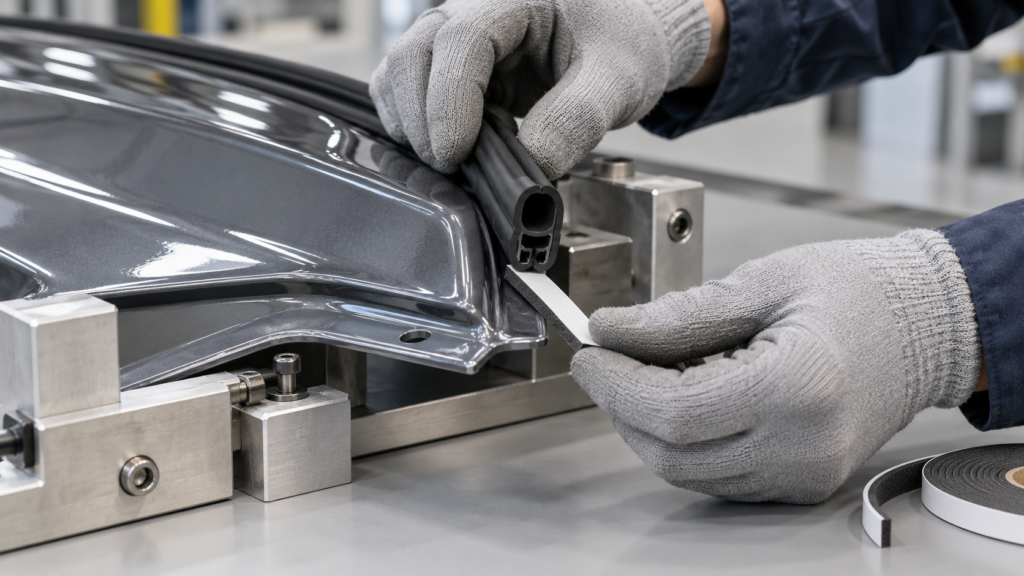
What must be verified before approving tape for bonding an automotive weatherstrip to clearcoat?
Identify both actual surfaces and adhesive architecture, reproduce the production process, and pass the OEM-defined assembled-joint tests with the proposed grade before approval. Product-family labels and competitor data do not qualify a specific pair.
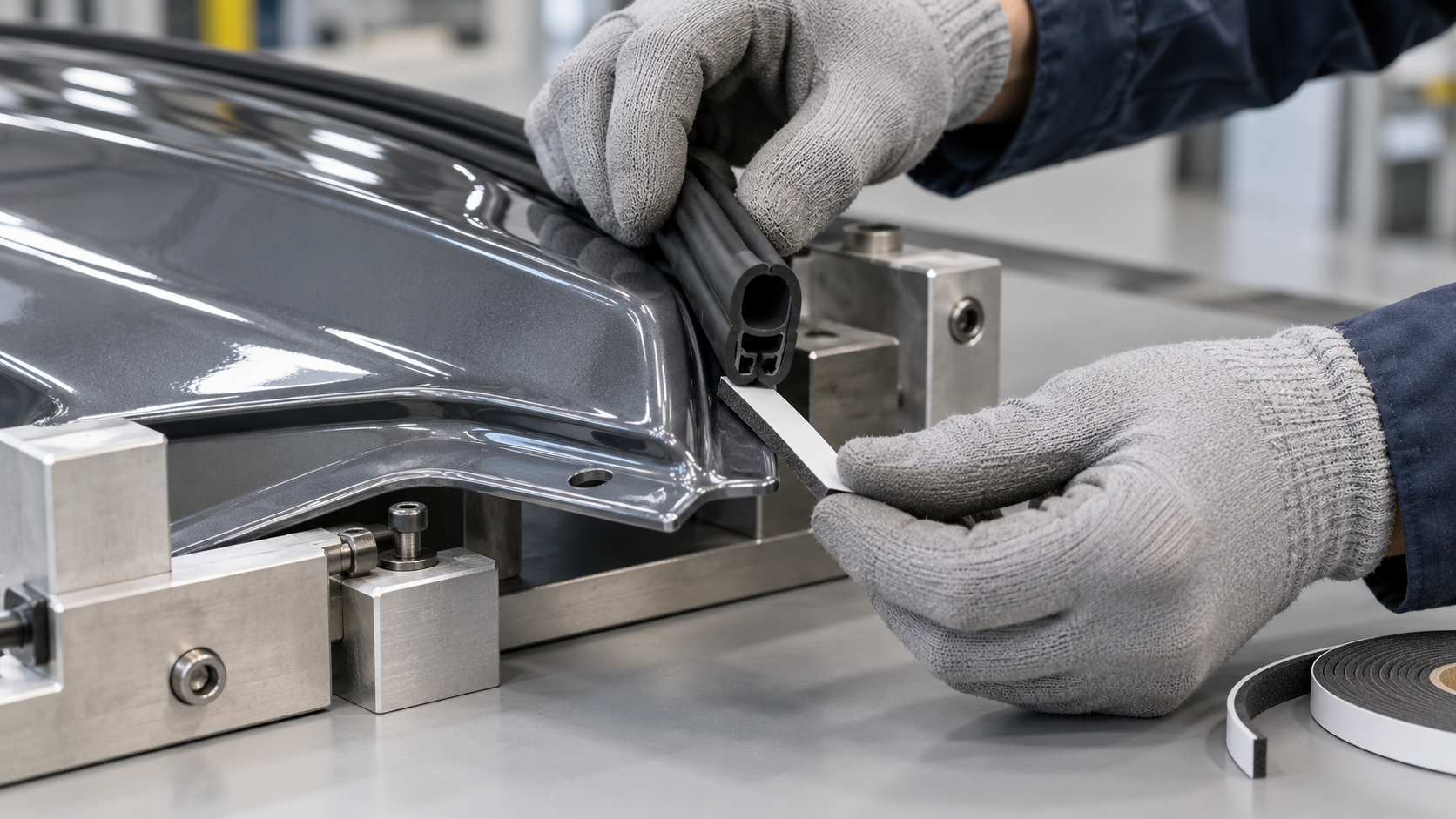
This is preliminary B2B guidance. 3M and tesa sources describe their named products only. LubandArt publishes double-sided PSA PE foam and an automotive weatherstrip application route, but no named grade is approved here for a specified seal compound, clearcoat or vehicle program.
A tape that holds an automotive weatherstrip during assembly is not qualified by the words “foam tape” or “automotive grade.” The release decision for automotive weatherstrip tape clearcoat qualification is whether a named construction bonds to the exact weatherstrip and the actual vehicle finish, using the production process, and then meets the vehicle program’s retention and appearance criteria. Identify both actual surfaces and adhesive architecture, reproduce the production process, and pass the OEM-defined assembled-joint tests with the proposed grade before approval.
For a double-sided PE foam tape, both adhesive faces are pressure-sensitive. That architecture is different from a product designed with a heat-activated adhesive on the elastomer side and a pressure-sensitive adhesive on the painted-panel side. The two approaches may address different surface and manufacturing needs; they are not interchangeable without testing.
Start with the two surfaces and the bond architecture
Record the exact formulation/revision and surface state, then test the actual adhesive contact face. Write down the weatherstrip compound and revision, including whether the adhesive touches EPDM, TPE, a coating, flocking, or another treated surface. On the body side, identify the paint and clearcoat system, revision, cure history, texture, and any handling or release-agent exposure. “Rubber to paint” leaves too many unknowns for a qualification plan.
Next, draw the proposed layer stack. A double-sided PE foam tape normally places pressure-sensitive adhesive on both sides of a foam carrier. Confirm which face contacts the seal and which contacts the clearcoat, along with liner, thickness, width, splice or die-cut format, and any primer or surface treatment actually permitted by the vehicle program.
Confirm the exact layer stack and follow only the named grade process; do not transfer 3M process or values to LubandArt. A useful comparison is 3M Attachment Tape 4981. Its technical data sheet describes a specific construction with a heat-activated adhesive intended for EPDM or Santoprene materials and a pressure-sensitive adhesive for surfaces including automotive paints. That is evidence that asymmetric adhesive constructions exist for defined applications; it is not evidence that this product, its values, or its process applies to a LubandArt grade. The relevant engineering question is whether the proposed tape architecture matches both interfaces and the available line process. A separate tesa ACXplus 74508 Seal Line product page describes a named tesa product; it is not equivalence or performance evidence for LubandArt.
LubandArt’s PE foam product page describes a PE foam carrier with pressure-sensitive adhesive on both sides, with configurable dimensions and adhesive system. The automotive route lists weatherstrip mounting among application examples and directs buyers to confirm the suitable family by project brief and sample testing. Those pages support discussing a candidate family; they do not establish compatibility with a particular clearcoat, seal compound, or OEM program.
Check geometry, compression, and stress
Use representative path, corners, tolerances, contact area and installed compression in the trial. Weatherstrip joints are not flat peel coupons. Record the seal cross-section, bond land width, path length, corner radii, joints, splices, and the variation expected from extrusion and body-panel tolerances. Check whether the tape follows the path without wrinkles, bridging, edge overhang, or local gaps. For a formed or curved section, inspect the installed part at worst-case geometry rather than relying only on a nominal drawing.
Then establish the seal’s operating condition. Is the adhesive joint only retaining a seal whose compression is controlled by the door or panel design, or is the joint expected to resist a sustained peel or shear load? Define the installed compression and the source of that load. The tape should not be treated as a substitute for the seal’s mechanical retention features or for a design that controls compression.
Set measurable observations before making samples: position shift, edge lift, visible squeeze-out, bondline exposure, local separation, and any change to the seal profile. Agree the acceptable limits with the OEM or responsible design authority. There is no universal thickness or compression value that can be selected from a family name alone.
Reproduce the manufacturing process
Record tape construction, liner, surface prep, sequence, pressure, dwell, temperature and line timing; validate heat activation only when required by that named construction. A sample made by hand can hide problems that appear on the line. Record how the weatherstrip is cut or extruded, how the tape is converted and linered, how the operator or equipment locates the part, and how pressure reaches the bond area. Include surface preparation only as specified for the actual materials and candidate adhesive system; do not copy another supplier’s cleaning method without confirming it is permitted for the paint and seal.
For a pressure-sensitive construction, define application pressure, contact sequence, dwell before handling, part temperature, and time between bonding and test. For a heat-activated construction, the process also needs a controlled activation method and thermal window suited to the exact seal and adhesive. These are different process plans. Do not apply heat-activation assumptions to a double-sided PSA PE foam tape.
Use production-representative tools, operators or equipment, liners, and parts. Include realistic line speed and handling if they affect placement or contact. Log the conditions so that a passing sample can be repeated, and so that a failed sample can be traced to the interface, geometry, or process rather than guessed at afterward.
Build a qualification matrix around the program
The OEM should define the service profile and acceptance criteria. Depending on the vehicle location, the plan may need specified temperature cycling, humidity or water exposure, vibration, cleaning chemicals, or aging conditions. Include only conditions required for the application; a generic checklist is not a substitute for the vehicle specification.
Test assembled joints made with the named clearcoat and weatherstrip, not just isolated adhesive coupons. Inspect retention and position before and after conditioning, then document failure location and appearance. If a failure occurs, distinguish adhesive separation from cohesive failure, substrate damage, seal deformation, or paint damage. A single peel result cannot answer every question about a long, curved weatherstrip joint.
Run named-grade samples on specified seal and clearcoat using the production process and program-defined environmental and retention criteria. Use a staged decision: first screen whether the candidate wets out and stays in position on the exact surfaces; next evaluate representative geometry and line application; finally run the program-defined environmental and durability tests. Set pass/fail limits in advance. If the material pair, process, or acceptance criteria change, assess whether the evidence still applies before carrying the approval forward.
What to request before approving a candidate
A supplier review can move faster when the request includes the weatherstrip compound and surface condition, paint/clearcoat system and revision, joint drawing and tolerances, seal compression and retention method, application sequence, line conditions, required exposures, and OEM test methods. Ask for data on the exact proposed grade and construction. A family-level page or another supplier’s technical sheet is not a grade-specific qualification report.
The practical release rule is simple: approve only the construction that was tested on the specified seal and finish, in representative geometry, using a repeatable process, against the program’s written criteria. If a specific LubandArt grade has not been tested on that combination, treat it as a sample candidate and request a scoped evaluation. The public PE foam and automotive pages identify possible project routes, not an OEM approval or guaranteed clearcoat compatibility.
For the product-family construction, see the LubandArt double-sided PE foam tape product page and LubandArt automotive tape applications. The PE foam versus acrylic foam tape guide explains the carrier distinction; the PE foam tape joint qualification guide covers a separate appliance-joint use case.
Frequently Asked Questions
Can double-sided PE foam tape bond EPDM weatherstrip to automotive clearcoat?
It may be evaluated as a candidate, but the family name does not establish compatibility. Test the exact seal compound, finish, geometry and process with the proposed grade against the vehicle program requirements.
Is double-sided PSA PE foam the same as heat-activated weatherstrip attachment tape?
No. Double-sided PSA uses pressure-sensitive adhesive on both faces. Some named products use different adhesive types on each face, including heat-activated seal-side adhesive. Confirm the candidate construction and its required line process.
What information should I send for a sample review?
Send the weatherstrip material and revision, paint/clearcoat details, joint drawing, compression and retention design, application process, service exposures and OEM acceptance methods. Include the proposed grade and ask for evidence on that exact combination.
Send the weatherstrip material/revision, clearcoat system, joint drawing, compression/retention design, process sequence and OEM acceptance criteria to scope a candidate sample trial.
Request a quote · [email protected] · WhatsApp +86 180 6469 2463
Need this construction for a production run?
Get a quote