
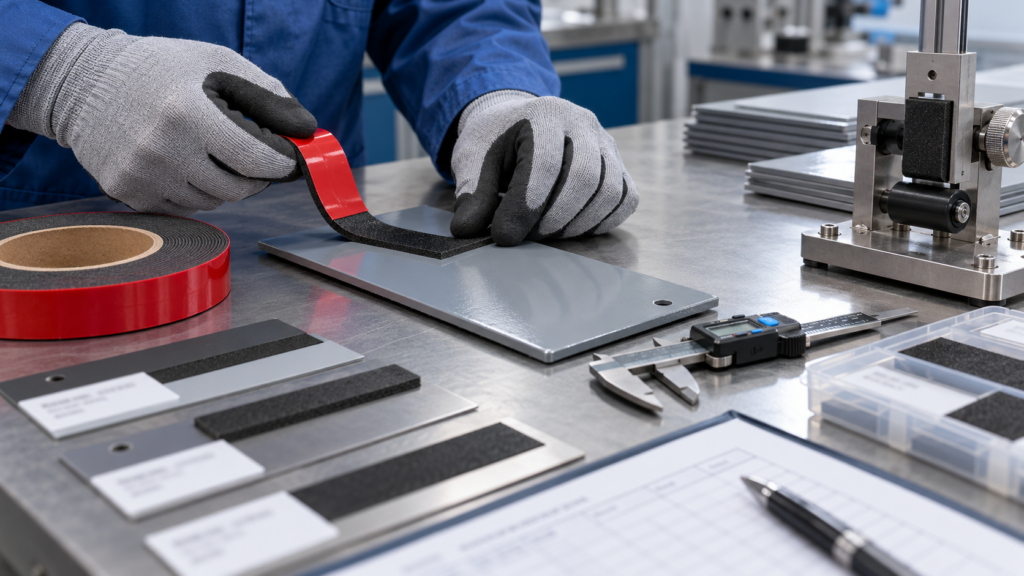
What evidence should an OEM require from an acrylic foam tape supplier before releasing a specific construction for production?
An OEM should approve an acrylic foam tape grade only when grade-specific evidence and a representative trial meet its defined assembly criteria.
figures and test-method references in this guide are for preliminary selection only. Final performance depends on the exact construction, thickness, substrate, application and test method; request the report for the proposed grade before approval.
When an OEM reviews an acrylic foam tape supplier, approval requires more than a family name or a headline adhesion value. Record an exact grade and revision, the methods and substrates behind the cited results, the sample conditions and the buyer’s acceptance criteria before testing. If the report does not describe the proposed construction or production interface, treat the tape as a candidate, not released material. This OEM sample qualification process keeps an acrylic foam tape construction tied to the evidence and production joint it is meant to support.
That distinction matters because “acrylic foam tape” describes a family, not one interchangeable material. Foam thickness, adhesive formulation, liner, substrate finish, bond geometry and application process can change the result. The OEM owns the assembly requirements; a supplier can help define a candidate and provide evidence, but cannot infer approval from the family name alone.
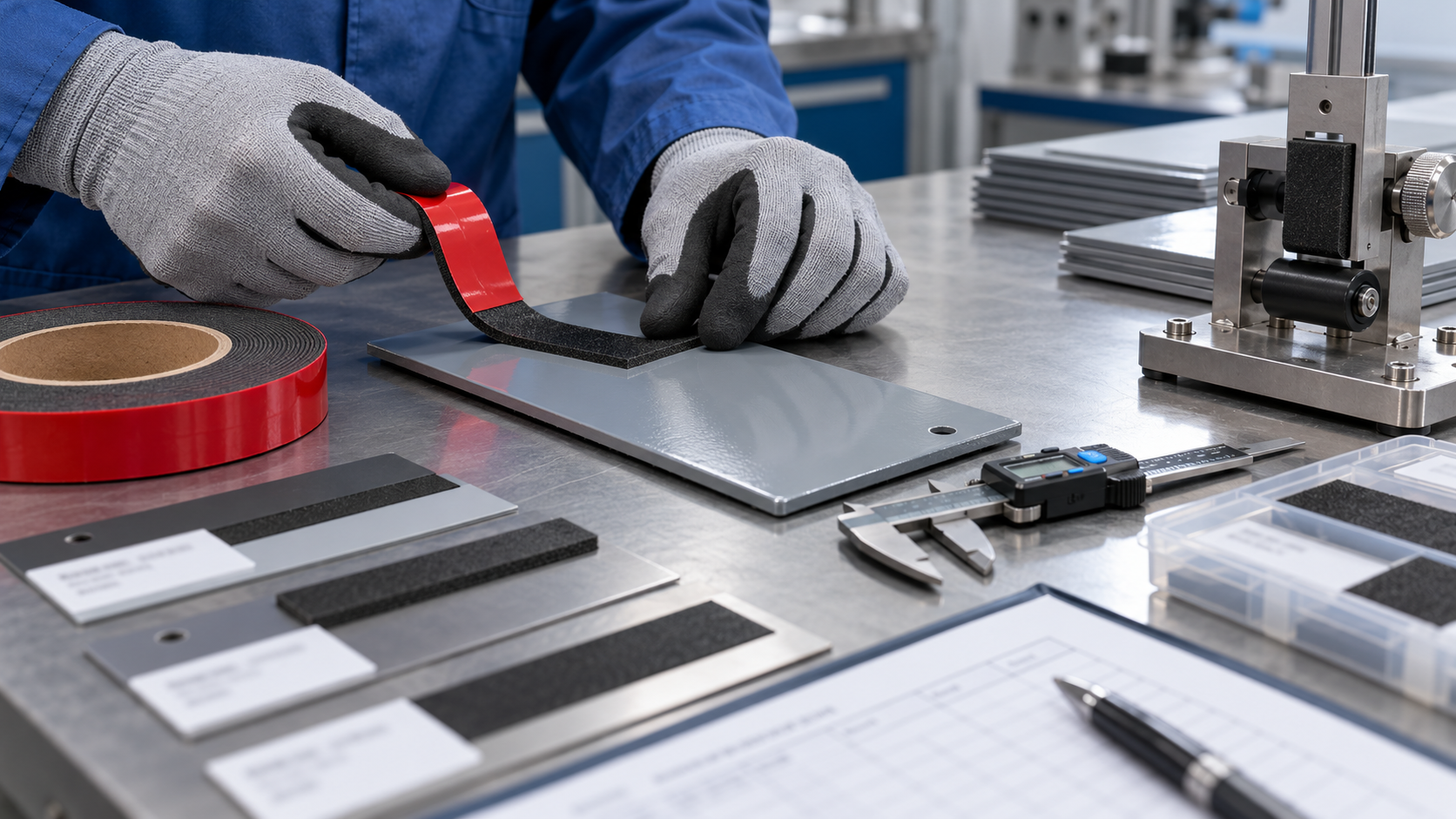
Define the assembly and the failure that matters
Before sending an RFQ, describe the job the tape must perform. Is it joining a trim to a panel, attaching a cover, reducing vibration, accommodating a gap or holding a decorative part? State whether the joint is structural, safety-related, weather-exposed or cosmetic. If a mechanical fastener carries the primary load, say so. If the tape is expected to retain the part by itself, that is a different design decision and may require engineering review beyond a general product guide.
List the two bonded surfaces precisely. “Painted metal” is not a complete substrate description: the alloy, coating chemistry, surface texture, cure, age and contamination can matter. For plastics, identify the resin and any molded release agent or coating. For each surface, clarify whether it is the production face and whether it will be cleaned, abraded or treated before application. A lab coupon made from a convenient substitute may screen candidates, but it does not represent the actual assembly unless the substitution is justified.
Then define the loading and service conditions that decide acceptance. Include the part mass and bonded area, the direction of load, shock or vibration, temperature range, humidity or water exposure, chemicals, UV exposure, and the time the joint must last. Identify the failure consequence: a slight edge lift may be cosmetic in one assembly and a functional failure in another. These inputs determine what the supplier should report and what the OEM must test.
Require an identifiable construction, not just a family name
Ask the supplier to identify the proposed grade, revision, foam core or carrier description, adhesive system, nominal thickness, liner, width and any converting format. The answer should distinguish published standard options from a custom construction. If the supplier changes the adhesive, foam, liner or thickness during sampling, the sample no longer represents the same construction and the change needs to be recorded.
A useful quote or sample record connects the proposed material to the project: grade and revision, sample or lot identifier, substrate pair, application method, test conditions, result and any limits that remain open. Match the grade/revision, construction, sample or lot, test method, substrate and finish, preparation, dwell, conditioning and failure mode on the report to the quote and sample. Ask whether the cited technical data sheet and report refer to the exact proposed construction. If they refer only to a similar family, treat them as background evidence, not as proof that the new grade will pass.
LubandArt’s acrylic foam tape product page describes a customizable product family and directs buyers to confirm final suitability against project specifications and sample testing. It can start a supplier discussion, but the available page does not approve every substrate pair, load case or service environment. For broader interface questions, review the surface preparation and bond strength guide; it does not replace the selected grade’s instructions or the OEM’s validation.
Read test figures with their conditions attached
A peel, shear or tensile number is useful only when the test setup is known. Request the method, sample preparation, substrate, coating, tape width and thickness, dwell time, conditioning, test speed, temperature and failure mode where those details apply. A value measured on stainless steel after a defined dwell cannot automatically be used to predict performance on a powder-coated panel after humidity exposure.
Separate initial screening from qualification. A small coupon test can compare candidates under controlled conditions. A production-representative trial should use the actual surface finish, part geometry, application pressure or fixture, operator or equipment sequence, and the time between application and loading. If the assembly sees heat, moisture, cleaning chemicals or cyclic movement, include only the exposures relevant to the product’s real use and set acceptance criteria before the trial starts.
Published supplier data can help rank candidates, but it does not set the buyer’s pass threshold. For example, 3M’s VHB design guide documents surface-preparation and bond-development conditions for its products. Its surface preparation guidance says users must evaluate suitability for their application. These references explain why a buyer should request grade-specific conditions; their figures and instructions are not values for another supplier’s tape. Follow the proposed grade’s own instructions and validate the complete joint.
Make the sample trial repeatable
Write a short trial protocol before samples arrive. Identify the parts, materials and surface lots; the tape grade, lot and dimensions; the cleaning and drying sequence; application pressure or fixture; placement tolerance; dwell and conditioning; and the measurement points. Use representative production parts and finishes, the identified grade and lot, documented preparation and application, dwell and conditioning, relevant service exposure, pre-agreed acceptance criteria and recorded failure observations. Record photos and deviations. If several variables change at once, a pass or failure may not tell the team what to change next.
Choose observations that relate to the failure risk. Depending on the application, the OEM may check panel movement, edge lift, gap, appearance, peel or shear behavior, vibration response or post-exposure retention. Do not borrow a pass value from a competitor’s data sheet unless the test and requirement genuinely apply to the OEM’s assembly. When the result fails, classify where separation occurred and whether the failure was adhesive release, cohesive split, substrate damage or a process issue. Treat the observed mode as a clue for the next controlled trial, not as proof of root cause by itself.
Check production control and change communication
A successful sample is only one part of supplier qualification. Ask how the supplier identifies incoming materials and finished lots, records the approved specification, controls width and thickness, checks the converting operation, and communicates a material or process change. The required evidence depends on the OEM’s quality system and risk level. Do not assume that a certificate proves the particular tape grade will meet the assembly requirement; it addresses a defined management-system scope, not every application result.
For repeat orders, agree which characteristics are critical to the assembly and how they will be confirmed on the purchase specification or order record. Identify the approved grade and revision in the purchase specification, then agree which changes to adhesive, foam, liner, coating or converting geometry require notice and review. Define who must approve each change. If the supplier cannot provide a requested grade-level report, record that as an open qualification item rather than filling the gap with a family-level brochure.
Use a staged sourcing decision
A practical sequence is: screen a relevant product family; document the proposed construction; review the test evidence and its limits; run a representative sample trial; then release the approved specification and change-control conditions. Stop earlier if the application is safety-critical or has a code or certification requirement that the proposed supplier cannot substantiate. In that case, route the project to the responsible design authority and a system qualified for that use.
For a first technical discussion, send the supplier a drawing or bond-area sketch, substrate and coating details, part mass, load direction, service environment, assembly sequence, target volume and acceptance criteria. This makes the response specific enough to compare. A generic quote may be quick, but it cannot settle whether the proposed grade works in the actual joint.
The decision is not whether a supplier can name an acrylic foam tape. It is whether the supplier can identify a stable construction and support a testable route from sample to approved production specification. An OEM should approve an acrylic foam tape grade only when grade-specific evidence and a representative trial meet its defined assembly criteria. If the evidence stops at a product-family description, the material is still a candidate—not an approved solution. For adjacent construction trade-offs, see the PE foam versus acrylic foam comparison, and send the actual project conditions through LubandArt’s contact page when requesting a sample or quotation.
Frequently Asked Questions
Does an acrylic foam tape product page qualify a grade for my assembly?
No. A product-family page identifies a candidate route. Qualification depends on the exact construction, substrate finish, joint geometry, process and service conditions, then a representative test against your criteria.
Can I use a competitor’s published adhesion value to approve another tape?
No. A value is tied to a specific construction, substrate, preparation, method and conditioning. Use another supplier’s guide only as context for what to document; do not transfer its performance values.
What should I send with a sample request?
Send a drawing or bond-area sketch, substrate and coating details, part mass and load direction, service environment, assembly sequence, target volume and acceptance criteria. Ask the supplier to identify the exact sample grade and revision.
Submit the assembly drawing, exact substrate finishes, service conditions and buyer criteria for a proposed construction and sample review.
Request a quote · [email protected] · WhatsApp +86 180 6469 2463
Need this construction for a production run?
Get a quote