
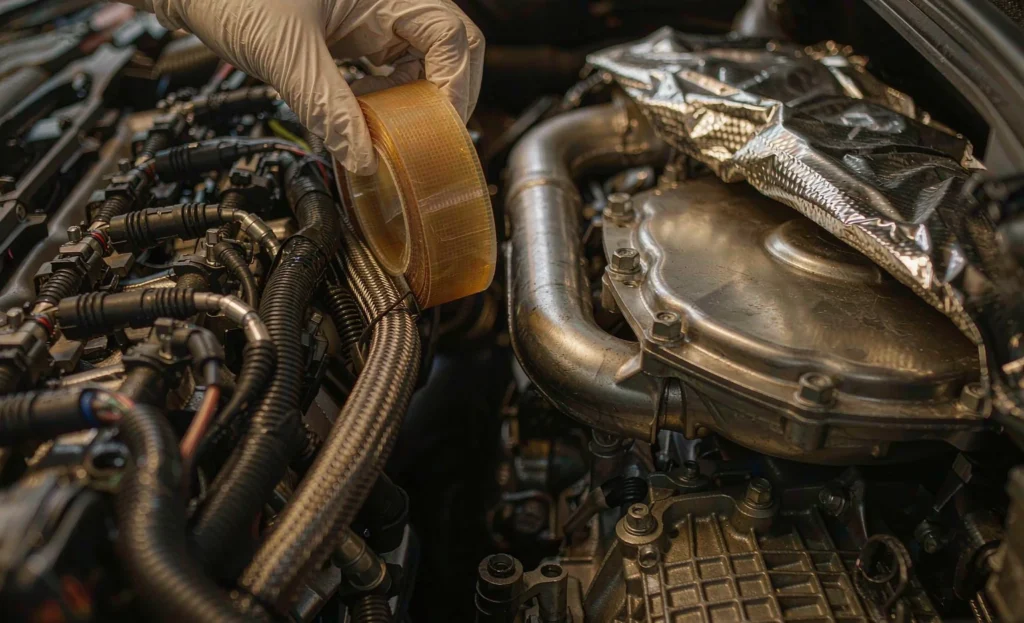
AUTOMOTIVE · THERMAL SELECTION
Heat Resistant Tape for Automotive Uses: Pick by Process Temperature, Not by Product Name
Choose automotive heat-resistant tape by the temperature class your process actually reaches — not by the product name on the roll.
Discuss your application# Heat Resistant Tape for Automotive Uses: Pick by Process Temperature, Not by Product Name
Start with the temperature class your process actually sees
When a buyer searches “heat resistant tape for automotive”, the first mistake is to start from a product name. The real decision starts with the process: what peak temperature does the tape see, and for how long? Temperature classes fall into bands — PET/polyester about 204°C, polyimide and glass cloth about 260°C, silicone-based constructions up to about 315°C. Ratings are duration-dependent; a material rated for 204°C may be specified as “204°C for 30 minutes”.
Set the temperature class from the worst-case peak temperature and exposure time: PET/polyester up to about 204°C for short cycles, polyimide or glass cloth up to about 260°C, and silicone-based constructions up to about 315°C. Ratings fall with longer exposure, so select on peak temperature plus duration, not the nominal average.
A powder-coat cure around 200°C for a short bake sits comfortably in PET territory. A paint bake that holds 200–260°C, or any process with longer dwell, pushes you to polyimide or glass cloth. Turbine-adjacent or exhaust shielding above 260°C needs silicone-based constructions. Pick the band from the worst condition on the line, not the catalogue headline.
Apply the silicone-residue rule next
The second filter is not temperature at all — it is contamination. Silicone adhesive gives the best heat resistance and the cleanest removal, but silicone residue can poison downstream re-coating, welding, or bonding. Silicone-based polyimide holds roughly -60 to 260°C long term and over 300°C short term; acrylic-based polyimide stays around -40 to 180°C with short-term 230°C and is prone to degumming above that.
If your downstream process forbids silicone residue (re-coating, welding, bonding), choose a silicone-free acrylic adhesive system (temperature class drops to about 180°C, short-term 230°C); otherwise a silicone adhesive gives the best heat resistance and clean, residue-free removal.
This is a genuine trade-off, not a downgrade: the acrylic system survives the heat but at a lower ceiling, and it avoids a contamination failure that no amount of tape temperature rating can fix.
Clean removal versus permanent wrap changes the adhesive
The third decision is what happens after heat. Masking and powder-coating defence are temporary: the tape must come off clean. Wire-harness and exhaust protection are permanent wraps that stay on the part.
Masking for powder coating or painting needs clean removal with a silicone adhesive; wire-harness or exhaust heat shielding can be a permanent wrap where mechanical strength and abrasion resistance (glass cloth) matter more.
Same temperature band, different end-of-life — and the adhesive is chosen for the exit condition, not just the peak.
Match the carrier to the surface geometry
Temperature class and adhesive decide whether a tape can survive; geometry decides whether it will actually fit the part. Glass cloth tape is about 7.2 mil and polyimide about 2.5–3 mil in powder-coating use. Carrier thickness drives conformability.
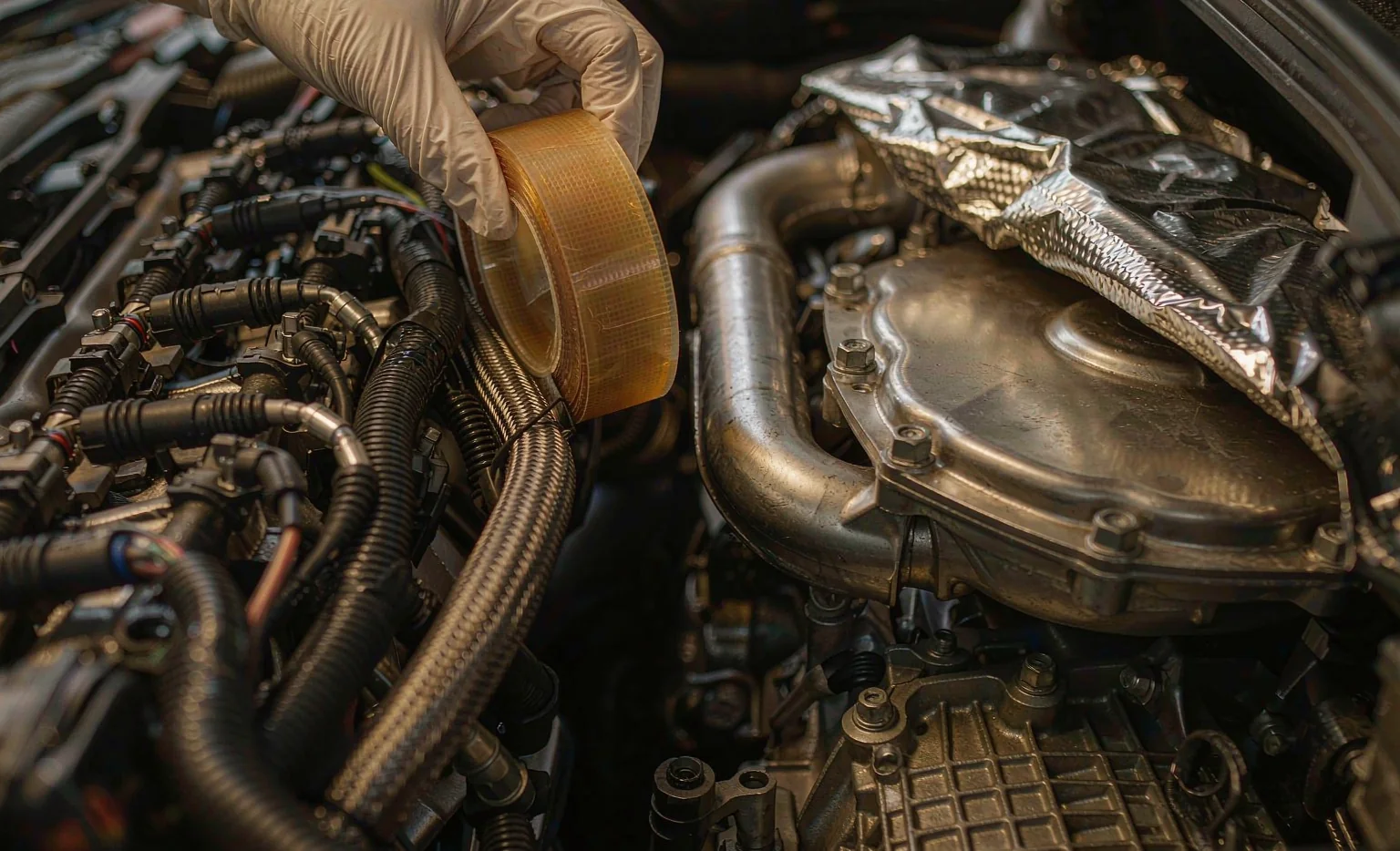
Use glass cloth (about 7.2 mil, abrasion resistant) on flat surfaces and heavy coatings; polyimide (about 2.5 mil, the thinnest edge) on tight radii and fine lines; conformable PET on curved surfaces.
Glass cloth is the workhorse for flat, abraded areas but too thick for tight radii; polyimide gives the sharpest masked edge; conformable PET follows curves that a rigid film will not.
Confirm die-cut or roll and line format
The last step is delivery format, not a material property — but it decides whether the spec reaches the line.
For volume production, die-cut shapes reduce hand trimming and improve consistency; confirm width, release liner and roll format match your labelling or wrapping equipment.
Next step
Submit your process peak temperature, exposure time, substrate and whether silicone is forbidden to get candidate temperature classes and a sample-validation plan. Form inputs to include: peak temperature and exposure time, substrate and surface state, whether silicone contamination is forbidden, geometry (flat or radius).
Discuss your application
Tell us the substrate, the joint and the service conditions. We reply with what fits and what does not.
Need this construction for a production run?
Get a quote