
For an OEM die-cut PE foam gasket, specify the part drawing, adhesive faces, retained liner, delivery orientation and a production-speed placement trial before volume purchase. The drawing must specify more than outer dimensions: the foam width around holes, corner radii, liner location and the direction the operator or robot removes the part. LubandArt’s PE foam tape page lists die-cut pieces, converted rolls and custom liners as supply options; that is a capability description, not proof that a proposed die will run at the buyer’s speed.
Start with the part’s job and the assembly motion
Keep cutting, stripping and placement as separate acceptance steps
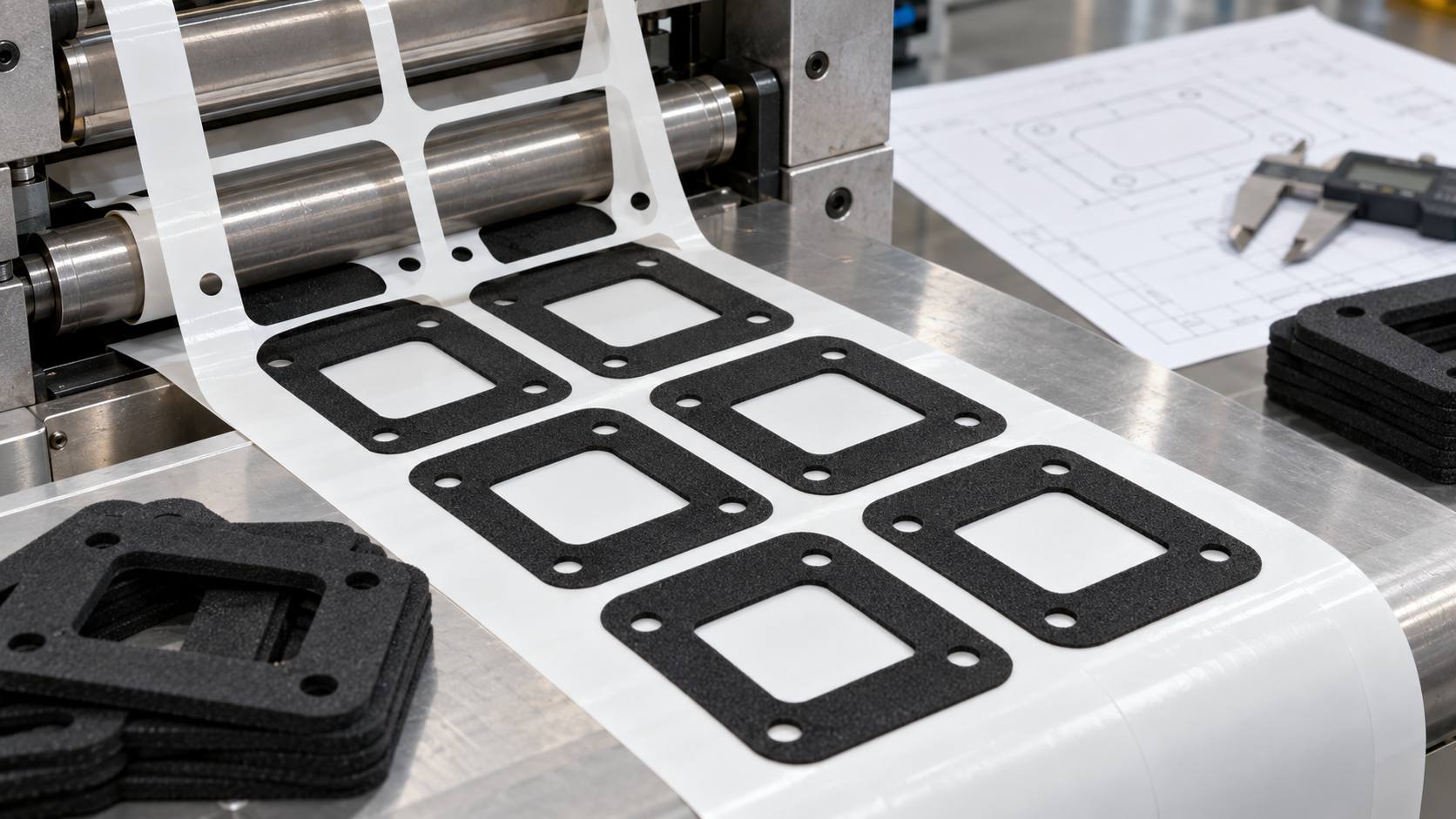
For kiss-cut parts on a roll, the liner should remain intact while waste matrix strips away. The part must stay on the intended liner through indexing, then release at the placement head. A full-cut part packed individually has a different handling risk: pieces can block, stretch or lose orientation. Specify which process is needed before requesting a price.
3M describes one PE foam tape as easy to die cut and used for gasketing, but that statement applies to that construction. tesa’s 62708 sheet also links non-sticky PE foam edges with die-cut conversion in a specific automotive trim grade. Neither source establishes a universal minimum web pitch or achievable feature size. The actual adhesive, foam density, thickness, liner and die determine those limits.
Put measurable details on the drawing
Show the part outline, aperture dimensions, tolerance on the sealing or mounting land, edge-to-hole distance, foam thickness without liner and finished-part orientation. State whether adhesive is on one or both faces. Identify the retained liner side and the side applied first. If a roll is required, add web width, part pitch, winding direction, core size and maximum outside diameter.
Ask the converter to report the first-article dimensions after cutting and after storage, not just the steel-rule die drawing. Soft foam can recover or stretch, so inspection timing must be fixed. For a gasket, measure the installed gap as well as the flat part; the die-cut outline alone cannot prove a seal.
Make the drawing useful to both the die maker and the assembly line
A part drawing should identify the functional land: the foam width that must remain around an opening or along an edge after tolerance is applied. Dimensions that affect a water path or trim location deserve tighter control than cosmetic outside edges. Add a view showing the part on its carrier liner, its top face, and the first-contact surface in the OEM process. Without that view, a converter can deliver a dimensionally correct part on the wrong liner side.
For a roll-fed design, give the pitch from a defined datum, the gap between adjacent parts, the winding direction and whether the matrix is supplied removed. For sheets, give sheet orientation and how the operator finds the first part. Ask for a sample layout before tooling approval. A drawing of a single flat piece cannot reveal whether the waste matrix will remain connected, whether a robotic head can peel one piece at a time, or whether the web fits the applicator.
Specify the release sequence, not merely a liner material
The liner must support the foam during cutting and transport, but it must also let the part release at the intended point. In a kiss-cut process, cutting too deeply can nick the carrier and cause web breaks; cutting too shallow can leave foam bridges that tear during removal. The converter should demonstrate both a clean matrix strip and intact liner at production speed. Ask which side of a double-sided part is exposed first, which side retains its liner for shipping, and how the liner is removed during assembly.
If parts are packed in bulk instead of on a web, define an anti-blocking method and an orientation rule. Soft foam edges can deform when heavy stacks are compressed in a carton. A protective liner may solve that handling issue but adds a removal step for the OEM. The lowest piece price is not the lowest applied cost if operators must separate stuck parts or discard misoriented pieces.
Inspect against the failure that matters
First-article inspection should sample the beginning and end of a converting run, not only the first acceptable part. Measure critical apertures, minimum land width, overall thickness without liner and registration relative to the web edge. State whether dimensions are checked immediately after cutting or after a defined recovery period. Because foam is compressible, the measurement method and contact force should be agreed before a tolerance dispute arises.
Then run the parts through the OEM’s application equipment. Record feed interruptions, matrix breaks, missed pickups, liner residue and placement error. For a gasket, finish with the assembled leak or compression test; for a mounting pad, test retention after the intended dwell and exposure. Acceptance of the converted part requires both dimensional conformance and successful use in the actual assembly sequence. That distinction should appear in the purchase order, not just in an engineer’s trial notes.
Approve production behavior before ordering volume
Run sample parts through the real equipment at target speed. Watch for liner cuts, matrix breaks, foam tearing, adhesive ooze and misfeeds. Fit the parts to representative panels and verify the functional test, whether that is a water leak test or a trim-retention test. A dimensionally acceptable part can still fail at automated release or in the assembled joint.
Send the drawing, substrate finish, planned process speed, monthly volume and packaging method with the RFQ. Request a sample and a production-run acceptance plan against those details. This separates an inexpensive quoted shape from a part that actually works on the line.
Frequently Asked Questions
Is a die-cut drawing enough to approve the part?
No. Define liner handling, part delivery and a production-speed converting trial.
Should the liner be cut through on a roll-fed gasket?
For kiss-cut roll-fed parts, the retained liner normally stays intact; verify that with the actual die and web process.
What should the first-article report include?
Measure critical dimensions after cutting and storage, and record matrix stripping, release and assembled fit.
Send part CAD drawing and tolerance, adhesive faces, liner retention and request a grade-specific sample and test plan.
Request a quote · [email protected] · WhatsApp +86 180 6469 2463
Need this construction for a production run?
Get a quote