
Choose PE foam tape for molded PP or PE trims by qualifying the adhesive on production parts; the foam carrier fills a gap but does not determine adhesion to the plastic. A supplier may offer acrylic, rubber or hot-melt adhesive on the same foam family. LubandArt’s PE foam page describes those options, but it does not identify a tested adhesive grade for every PP or PE formulation.
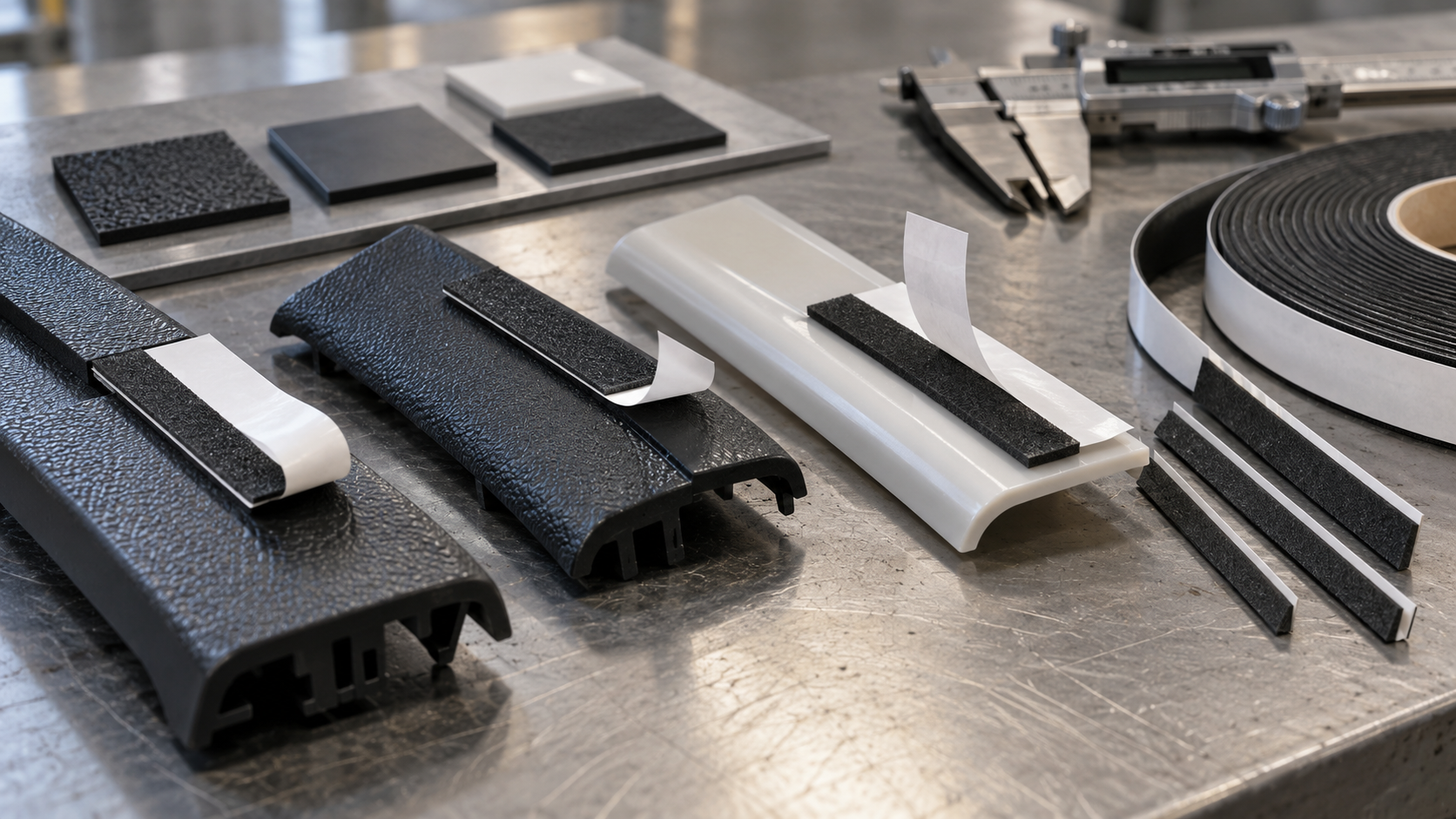
Do not infer plastic adhesion from the PE foam carrier
Start by requesting the actual molded parts, not only a resin name. Mold-release agents, texture, fillers, paint and surface treatment change the surface the tape sees. Test against production parts from more than one lot if the finish varies. A clean laboratory PP plaque can give misleading confidence for a textured, handled trim.
Shortlist the adhesive against the service conditions
tesa 64962 gives a concrete example: its double-sided PE foam tape uses synthetic rubber adhesive and is promoted for low-surface-energy substrates and plastic trim. That supports considering a rubber-based construction as a candidate. It does not mean all rubber adhesives bond all PP and PE parts, or that they are automatically suitable for heat and outdoor exposure.
3M’s 4496B PE foam tape data describes an acrylic adhesive construction with its own measured properties and application limits. A comparison between these brand examples is a screening exercise only; unlike-for-unlike test methods cannot rank LubandArt options. For the buyer, the practical decision is whether the specified adhesive passes peel or retention on the actual substrate after the expected dwell and exposure.
Treat the molded part as the test substrate
PP and PE are broad material labels, while the tape contacts a particular surface created by molding, additives and handling. A textured trim may offer less real contact area than a smooth plaque. Colorants, fillers and recycled content can change the surface from one purchase lot to another. Mold-release residue or a recently applied coating can dominate the first bond. Ask the plastic supplier for the resin and surface-treatment history, but do not let a resin datasheet replace a bond test on production parts.
Prepare samples from the normal process and, if the factory sees variability, from a second lot or tool cavity. Record whether the parts were washed, flame-treated, plasma-treated or primed. The objective is not to prove that one adhesive sticks to “PP” in the abstract; it is to establish a reproducible process for this specific trim. If treatment is needed, its durability between treatment and assembly also belongs in the validation plan.
Run a candidate matrix that can reject an adhesive
Select a small number of constructions with clearly different adhesive systems or surface-treatment requirements. Apply equal bond areas to identical parts using the same pressure and dwell. Test immediate handling strength only if the line needs it, then test final retention after the defined dwell. Add heat aging, thermal cycling or humidity only where the application requires those exposures. A candidate that passes immediate placement but loses retention after heat is not equivalent to one that survives service, even if both feel tacky to an operator.
Record where the joint fails: at the PP or PE face, at the mating face, within the adhesive, or through the foam. That observation narrows the next trial. If the plastic face releases cleanly, changing foam thickness may not help. If the foam splits while both adhesive interfaces remain attached, carrier strength or joint geometry deserves attention. A peel number alone cannot separate these mechanisms.
Make primer decisions explicit
A primer may improve a difficult interface, but it creates another controlled process: application amount, flash-off time, allowed storage before bonding and worker handling. If a primed construction is proposed, compare it with an unprimed candidate on total applied cost and process reliability, not only on a laboratory peel value. A primer that the OEM cannot apply consistently is not a viable production solution.
Ask the supplier to identify the exact face that contacts the plastic, especially if the tape has different adhesives on its two sides. Put that orientation on the drawing and packaging label. The approved sample should include its liner and winding format, because those determine which adhesive face the operator exposes first. This detail prevents a technically sound tape from being installed backward on the line.
Control the process that creates the bond
Record cleaning method, surface temperature, applied pressure, time before load and whether parts are assembled manually or on a fixture. A tape that sticks during an immediate hand pull may still release after a trim’s spring-back force acts for days. Conversely, early low adhesion may improve after dwell; judge at the time relevant to the assembly specification.
If surface treatment or primer is required, put that step in the production work instruction and validate it with the same parts. Do not quote a primer-free construction based on a supplier’s generic plastic list. For an RFQ, send PP or PE grade, finish and texture, sample parts, mating substrate, available bond area, load direction and thermal exposure. Ask for side-by-side samples of candidate adhesives with a defined test plan.
Frequently Asked Questions
Does PE foam tape automatically stick to polyethylene parts?
No. The foam carrier and surface-facing adhesive perform different jobs; trial the adhesive on actual molded parts.
Should a primer be used for PP trim?
Only if the selected adhesive and actual part require it, then include the primer process in production validation.
What samples should a supplier receive?
Send production molded parts from representative lots plus the mating material, finish, load and service exposure.
Send plastic grade and molded samples, surface texture and release agent, mating substrate and request a grade-specific sample and test plan.
Request a quote · [email protected] · WhatsApp +86 180 6469 2463
Need this construction for a production run?
Get a quote