
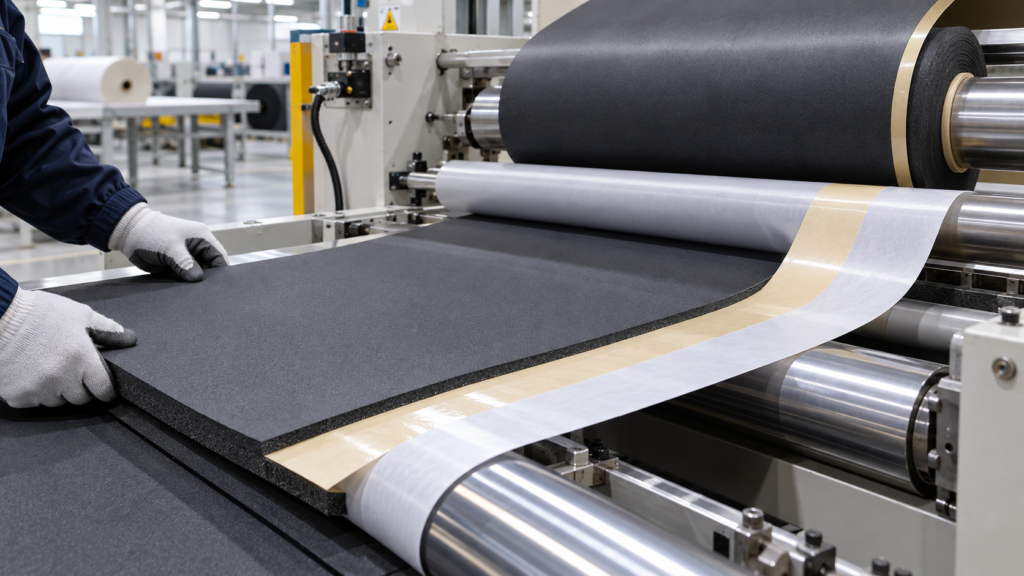
When a converter needs to join polyethylene foam to itself or to another foam layer, the adhesive interface is often the part that decides whether the laminate survives converting and assembly. For polyethylene foam lamination, bonding polyethylene foam depends on the foam skin, surface condition, contact area, compression and line process. Trial double-sided PE foam tape where a thicker compliant or gap-filling layer is needed; consider transfer construction for a flatter, thinner interface. Confirm the exact foam faces, line conditions and failure mode on representative production samples before release. Neither option can be approved from the words “PE foam” alone. Identify the actual foam grade and qualify the construction on representative material before release.
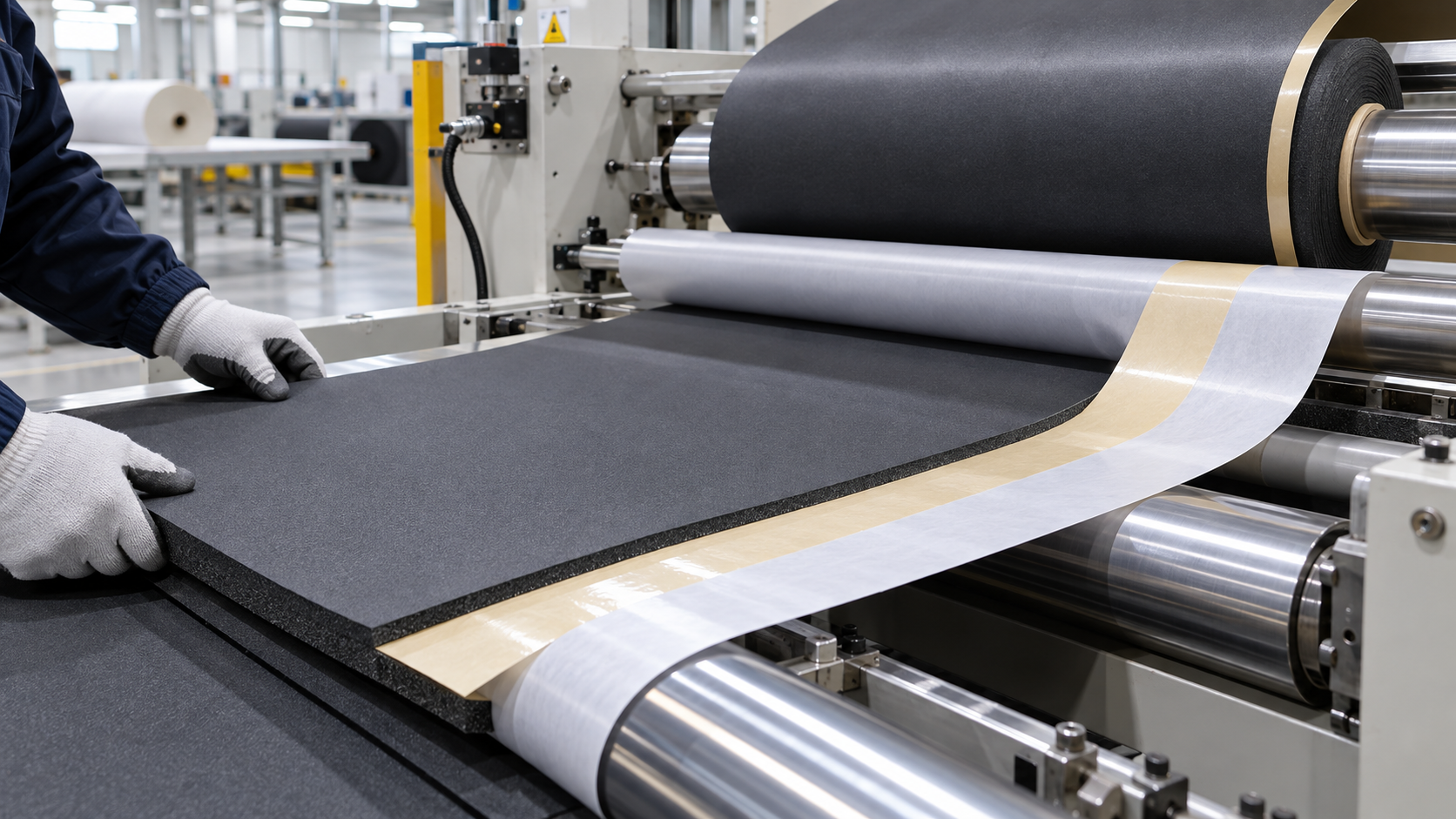
This guide is for industrial foam converters and OEM process engineers. Polyethylene foam formulations, skin quality, density, texture and surface treatment vary. A tape that bonds to one foam sample may not bond to another lot or grade. The published LubandArt product range is a starting point for discussion, not a blanket claim that a particular construction bonds every PE foam surface.
Confirm what is actually being laminated
Start with the two surfaces that will meet. Record the foam supplier and grade, density, thickness, cell structure, color, and whether the bonding face is a smooth extrusion skin, a cut surface, a textured face or a treated face. If the second layer is a different foam, film, fabric or foil, record that material separately. “PE foam to foam” is not a complete substrate description.
Ask whether the faces have been corona, flame or plasma treated, and when that treatment occurred. Do not assume treatment is present because the material is described as PE. Dust, release agents, slip additives, skin variation and storage can change the surface. The bonding face should be clean and dry, but cleaning agents and surface treatment must follow the foam maker’s instructions and be checked for compatibility. Record the actual process instead of applying an unverified primer or solvent.
The distinction matters because PE is a low-surface-energy material. 3M’s general low surface energy bonding guidance discusses PE and foam lamination as bonding contexts; it does not establish that any named tape will work on a specific PE foam. Treat it as a reason to test the interface, not as a performance promise.
Choose the construction around the interface
A double-sided foam carrier can be worth trialing when the surfaces are uneven, the assembly needs a thicker bond line, or the joint benefits from some compliance and gap filling. LubandArt’s double sided PE foam tape page lists a closed-cell PE foam carrier, typical thicknesses from 0.5 to 8.0 mm, and jumbo, slit-roll and die-cut formats. The page also states that the final construction and substrate suitability must be confirmed against the project specification and sample test. Do not treat the displayed range as a guarantee for foam-to-foam adhesion.
A carrier-free transfer tape can be considered when the interface is flatter, thinness matters and the converting line can handle the adhesive and liner without a foam carrier. See the substrate free tape product page for the offered format, then ask for the proposed adhesive system, thickness and liner for the actual foam surfaces. A thinner construction is not automatically a better bond: if the foam face is rough or compressible, incomplete contact may dominate.
The choice should reflect the failure you are trying to prevent. If the foam layers separate at an edge during die cutting, winding or handling, examine peel initiation and edge coverage. If the laminate slips under a sustained load, evaluate shear and creep under the real temperature and load. If the foam crushes or recovers unevenly, check how application pressure and the carrier affect thickness and compression. These are different failure modes, so one catalog peel number cannot answer all of them.
Control lamination conditions
A hand-applied sample can conceal process problems. For a pilot, use the intended laminator or a documented simulation. Record web speed, nip or application pressure, roller condition, alignment, tension, material temperature and the time between lamination and testing. Excessive pressure may compress soft foam; insufficient pressure may leave areas with poor adhesive contact. Establish the working range on the actual line rather than copying a pressure value from another supplier’s product sheet.
Use the same foam lot and surface preparation for each candidate. If the foam face is cut or textured, keep the cut direction and surface condition consistent. Apply the tape without stretching it, avoid trapping debris or air, and allow the specified dwell or conditioning period before comparing samples. A 3M PE foam tape data sheet points users to lamination equipment guidance for wide-web application. That is a useful reminder that equipment and process control matter; its numeric performance data applies only to that 3M grade and test setup.
For background on foam material differences, see LubandArt’s PE foam versus EVA foam guide. For surface preparation principles, see the surface preparation and bond strength guide. Neither replaces testing on the exact foam faces in your process.
Run a sample trial that exposes the real failure
Agree on the sample geometry and acceptance criteria before the trial. Include the production foam, bond width, edge condition and any die-cut or winding steps that the laminate will experience. Compare candidate constructions under the same conditions. A practical trial record includes:
- foam supplier, grade, lot, density, thickness and bonding-face description for both layers;
- tape construction, adhesive system, liner, thickness and roll or converted format;
- surface preparation, treatment age, application pressure, line speed and temperature;
- conditioning time and environmental exposure before testing;
- peel initiation at the edge, cohesive foam tear, adhesive transfer, clean release or interfacial separation;
- laminate thickness and compression recovery where these affect the finished part;
- the sample count and pass/fail criteria agreed by engineering and quality.
Use a peel method only when it reflects the decision you need. ASTM D3330/D3330M describes methods for assessing pressure-sensitive tape peel adhesion under defined conditions and notes that response can depend on the tape backing and adhesive. A standard-panel result is not a complete qualification of a foam laminate. If your assembly is exposed to heat, moisture, vibration or sustained compression, add the relevant application test and define how the foam itself may deform or fail.
Inspect the failure surface, not just the peak force. Adhesive left on one face, foam tearing, clean interfacial release and edge lift point to different causes. If the foam tears, the failure may be limited by the foam rather than the adhesive. If release is clean, confirm the surface condition, adhesive compatibility, application pressure and dwell before changing tape thickness. Keep photos and lot references with the test record so the next trial can reproduce the conditions.
Put the process into the RFQ
Send the supplier a small, complete brief: foam grades and data sheets, which faces are joined, thickness and density, bonding area, surface treatment, converting format, line conditions, service environment and the failure mode that matters most. Include a drawing or sample if the part has contours, cutouts or edge constraints. State whether you need jumbo rolls, slit rolls, sheets or die-cut parts and provide target tolerances.
Ask the supplier to identify the proposed construction and its limitations, provide the grade-specific technical data available, and prepare samples using the production foam. Agree on a trial protocol and acceptance criteria before approving volume production. If those details are not available, keep the material at sample-evaluation status rather than treating a generic description as a released specification.
Frequently Asked Questions
Will double-sided PE foam tape bond every PE foam surface?
No. Foam skin, additives, texture, treatment, contamination and application conditions vary. Confirm the exact material and qualify a proposed grade on production-representative samples.
Should I use foam tape or transfer tape for foam lamination?
Consider foam-carrier construction when the interface needs a thicker, compliant or gap-filling layer. Consider transfer construction for a flatter, thinner interface and a process that can handle it. Test the actual foam faces.
Can I approve a tape from a peel value alone?
No. Peel is one response under defined conditions. Observe the failure mode and add the shear, compression, aging or process tests that match the finished laminate.
What should I send for a sample recommendation?
Provide both foam grades and bonding faces, thickness and density, surface treatment, bond geometry, converting conditions, required format, service environment and acceptance criteria.
Send both foam grades and bonding faces, the part drawing, line conditions and acceptance requirement to request a candidate construction and sample trial plan.
Request a quote · [email protected] · WhatsApp +86 180 6469 2463
Need this construction for a production run?
Get a quote