
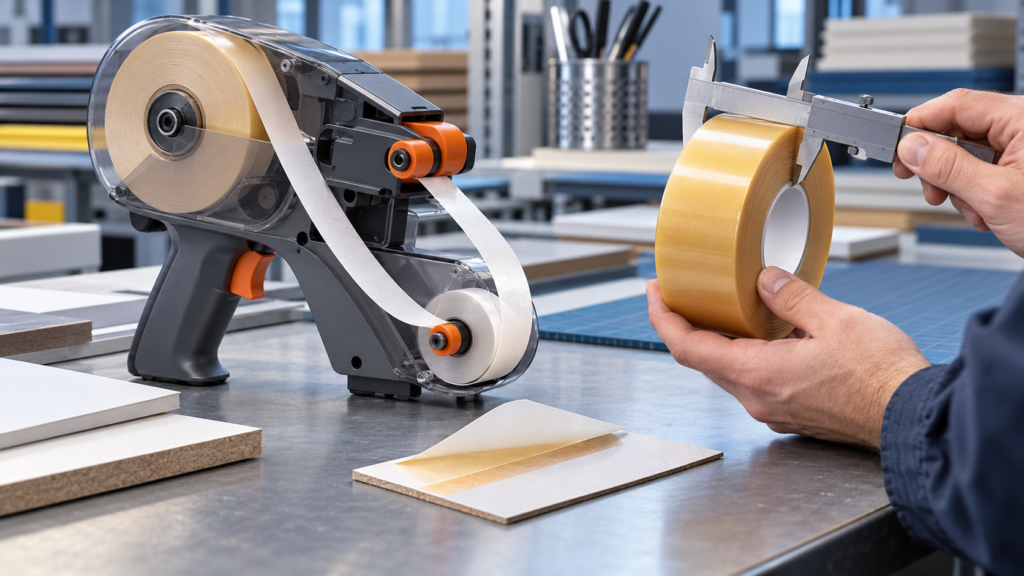
What must match before an adhesive transfer roll can be used in this specific ATG applicator?
Verify the exact applicator model and adapter, usable tape width, core ID, maximum roll diameter, winding direction, liner orientation and take-up path against the device documentation and a production trial. Do not infer fit from the generic ATG label.
Model-specific sourcing guidance only. 3M dimensions and performance apply to named 3M products; no LubandArt ATG-ready grade or substrate-pair performance report is established. Confirm conversion capability and validate both dispensing and bond performance before release.
An ATG-style hand applicator can apply a narrow adhesive transfer film while winding the spent liner into the tool. This guide is aimed at print finishing and tape converting teams. The roll therefore has to match the applicator’s feed and liner path as well as the bonding job. Before ordering, verify the exact device model, tape width, core, winding direction, roll diameter, liner behavior and intended substrates. A product described as “transfer tape” is not automatically compatible with every ATG applicator.
For LubandArt buyers, the substrate free tape family is a configurable product-family route. Its page lists custom width, roll length, liner, and core options but does not claim ATG compatibility. Treat this as a custom-conversion question that needs written confirmation and a device trial, not as an established product claim. This guide concerns an adhesive transfer roll for a named ATG applicator; that is the buying decision, not a currently approved LubandArt SKU.
The Ads export shows 480 average monthly searches for “ATG tape” and 320 for “Scotch ATG 700,” with bid estimates of USD 0.46–7.23 and USD 0.48–6.30 respectively. Ads search metrics are opportunity proxies; no matching GSC or attributed inquiry was observed. These figures have mixed consumer and business intent and do not prove qualified commercial demand.
Start with the applicator model, not the ATG label
Record the manufacturer and full model number from the applicator, including any adapter installed. “ATG” is commonly used as shorthand for adhesive transfer guns, but model constraints are specific. For example, 3M describes ATG Tape 976 as reverse wound on a 1-inch core for Scotch ATG dispensers. Its 3M ATG Tape 976 technical data sheet gives the named product’s details. The 3M ATG 700 product page lists model-specific width and adapter constraints for its ATG 700 applicator, including supported roll widths and an adapter option. Those details apply to those named products; they do not establish the fit of a different gun or a custom roll.
Verify the exact applicator model and adapter, usable tape width, core ID, maximum roll diameter, winding direction, liner orientation and take-up path against the device documentation and a production trial. Do not infer fit from the generic ATG label.
Check the current manual or manufacturer’s specification for the exact tool. Capture the allowed tape width, core inside diameter, maximum roll diameter, roll length or capacity, and the required feed orientation. If the tool has a take-up mechanism for the liner, inspect how the liner exits the adhesive path and winds onto the take-up hub. Do not infer these dimensions from a photo of the gun or from a roll that appears similar.
If the applicator is an unbranded or third-party model, send its manual, a dimensioned sketch or a sample roll to the tape converter. Include the adapter part number where applicable. A sample roll can help identify the physical format, but the final specification should still name the model and dimensions so that later orders do not depend on visual matching.
Specify the complete roll geometry
A useful RFQ describes more than tape width. State the usable adhesive width, total roll width including liner, core ID, maximum outside diameter, roll length, and any leader or tab requirement. Identify the core material if the dispenser depends on stiffness or a particular fit. Where the tool accommodates multiple widths only with an adapter, name the intended adapter and roll configuration together.
Write the winding requirement unambiguously. Ask whether the roll is standard-wound or reverse-wound, which side of the liner faces outward, which surface carries the exposed adhesive at the application nose, and which direction the spent liner must travel. A side-view diagram with arrows is more reliable than “ATG winding” by itself. Confirm whether the liner stays continuous through the roll and whether a leader is needed to thread it into the take-up path.
That page does not publish an ATG reverse-winding specification. A converter should confirm that the required adhesive/liner construction and winding operation are available for the exact order before a buyer treats the offer as a compatible product. If the requested geometry cannot be confirmed, do not force the roll into the gun; consider another qualified application method or a different roll format.
Name the exact device/adapter, tape width, core ID, outside diameter, roll length, core, winding direction, liner orientation, take-up route and threading leader. Add a diagram where needed.
Match the adhesive transfer to the job
Applicator fit answers only whether the roll can be installed and dispensed. It does not answer whether the adhesive suits the bond. Name both substrates, including coatings, inks, release treatments and surface finish. Note whether the adhesive will bond paper to paper, a label to a coated panel, foam to a facing, or another material pair. Describe the bond area, whether the joint is permanent or repositionable, and the expected handling or service loads.
Transfer tape is an unsupported adhesive film supplied on a release liner. That construction differs from double-coated tape, which has a carrier between adhesive layers. The unsupported layer can suit thin or conformable bonds, but its handling, thickness and liner behavior differ. Select by the actual assembly and converting steps rather than assuming that a thinner construction is always better. Avery Dennison’s construction overview gives general context for transfer, single-coated and double-coated constructions; it is not a LubandArt product specification.
Specify the liner as a functional part of the roll. It must protect the adhesive before use, move through the tool without tearing or wandering, and release cleanly at the application point. Ask the converter to identify liner material, thickness, release side and any special leader. If adhesive transfers to the wrong surface, if the liner wrinkles, or if rewind tension changes as the roll diameter falls, the applicator trial has found a format problem even if a hand-applied coupon bonds well.
Run a device trial that can reject a bad format
Before bulk release, trial the proposed roll in the named applicator with the actual operators. Check threading, start-up, line tracking, liner rewind, adhesive placement, stops and restarts, and the last portion of the roll. Record skipped segments, adhesive strings, liner breaks, uneven application and any need to pull the tool harder than normal. Repeat across more than one roll if the format will be used in production; one successful pass can miss roll-to-roll variation.
Then evaluate the bond on production substrates. Clean and condition the surfaces using the approved process, apply the adhesive at the intended pressure and speed, and follow the specified dwell before testing. Define acceptance before the trial: placement tolerance, coverage, edge lift, peel or shear method, handling time and any relevant environment. A bond result on stainless steel in a supplier’s product sheet does not predict performance on the buyer’s paper, coating, plastic or foam.
Does a smooth dispensing trial prove the adhesive bond is suitable? No. Test the real substrate pair, surface preparation, application pressure and dwell, then judge against the buyer’s defined bond criteria. Smooth dispensing does not establish bond suitability.
Keep the two trial questions separate. First, does the roll feed and rewind correctly in this applicator? Second, does the adhesive joint meet the assembly requirement on these substrates? A pass on one does not prove the other. If a trial fails, record whether the failure is mechanical dispensing, liner release, adhesive transfer or bond performance, then change one variable at a time.
Lock the order specification after approval
The approved drawing or purchase specification should identify applicator make/model and adapter, tape construction, adhesive, liner, width, core, outside diameter, length, winding direction, liner path, and the tested substrate/application conditions. Retain a reference sample or photograph showing the roll orientation and threading path. Define what changes require a new trial: a different liner, adhesive, width, core, roll length, winding direction, applicator revision or substrate coating.
The 3M examples show why model-level checks matter: reverse winding, core and supported widths belong to named dispenser systems. They are useful prompts for a specification, not dimensions to copy blindly and not evidence that a LubandArt construction is compatible. LubandArt’s substrate free tape page provides a route for discussing a custom converted roll; a proposed ATG format still needs confirmation from the supplier and a successful trial in the buyer’s exact tool. For model and roll details, refer to the transfer tape construction guide and contact LubandArt.
For a compatibility review, send the applicator make and model, adapter, manual or roll drawing, target width and length, core and maximum diameter, winding/liner path, the two substrates, application rate and acceptance criteria. That information lets the supplier decide whether a sample format can be prepared and what the trial must prove. The product page describes a carrier-free, custom-converted tape family; exact compatibility still requires confirmation for the named device and construction.
Frequently Asked Questions
Will any transfer tape roll fit an ATG applicator?
No. Confirm the exact device and adapter, roll width, core, diameter, winding direction and liner path using its manufacturer documentation.
Does a 1-inch core mean the roll is compatible?
No. A core match alone does not establish width, outside diameter, winding or liner take-up compatibility.
Does a roll that dispenses smoothly prove the bond will last?
No. Dispensing and bond qualification are separate; test the intended construction on production substrates against the buyer’s criteria.
Send the exact applicator make/model and adapter, roll drawing, width, length, core, maximum diameter, winding/liner path, substrate pair, application rate and acceptance criteria for capability review and a sample trial.
Request a quote · [email protected] · WhatsApp +86 180 6469 2463
Need this construction for a production run?
Get a quote