
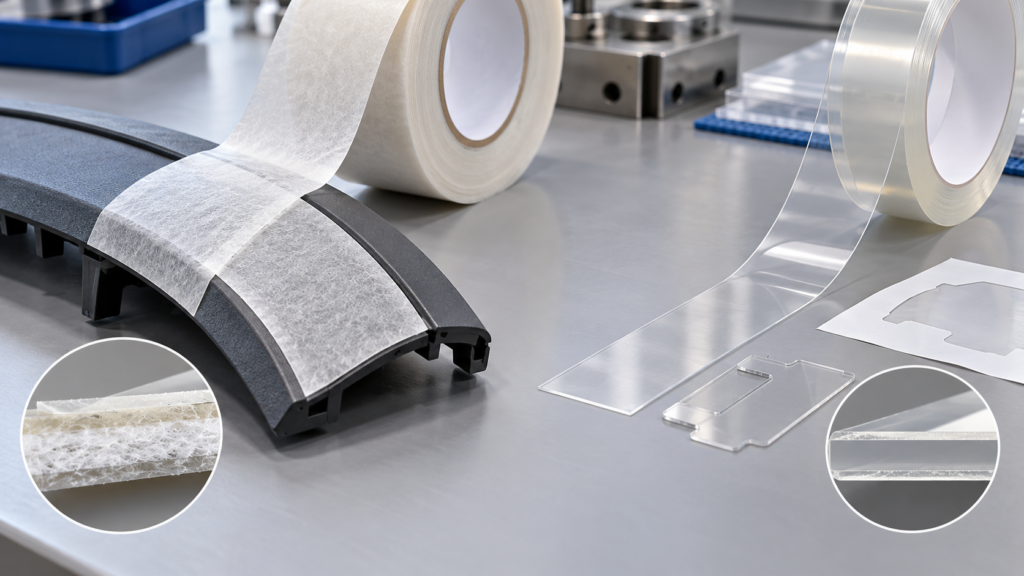
When a thin double-coated tissue tape part must follow a slight contour and still land accurately in an assembly, the carrier can change how reliably the converter makes and handles the part. Tissue carrier tape and PET film carrier tape are both options, but they solve different process problems. A buyer searching for double coated tissue tape should still compare carrier form against the job rather than assume the keyword alone determines the construction. Tissue is the more conformable option in LubandArt’s published product positioning; PET is positioned for dimensional stability and precision die-cutting. The right choice depends on the actual substrate, geometry, converting method and placement process, then needs confirmation with representative samples. Start with tissue when contour conformity dominates and PET when dimensional stability or registration dominates; compare representative parts through the real die-cutting, stripping and placement process.
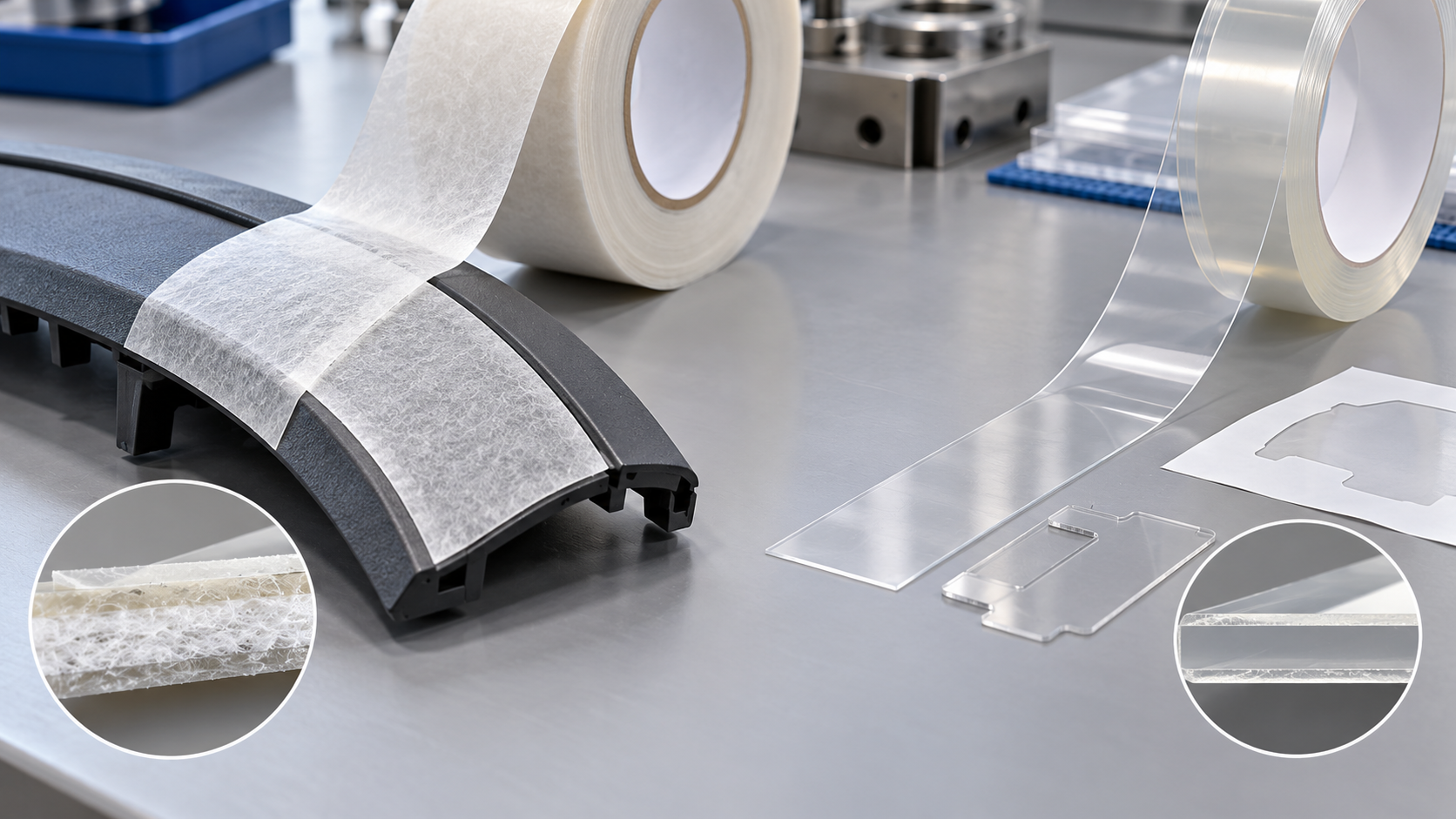
This comparison is for OEM engineers and tape converters specifying low-profile bonding parts. It does not assign a universal strength or durability ranking to either carrier. Adhesive chemistry, coat weight, total thickness, liner, surface preparation and application conditions can matter as much as the center carrier. Treat published ranges as typical product guidance and confirm the proposed grade and assembly before release.
Start with the part and the production problem
Before choosing a carrier, sketch the bonded part and write down how it will be made and applied. Is the component flat, lightly curved or textured? Is the die-cut tape applied by hand, by fixture or by an automated pick-and-place head? Does the process depend on a tight pitch, clean matrix stripping or repeatable placement? Does the bond line need to stay visually clear? A carrier should be selected against these requirements, not just the material name on a data sheet.
The first distinction is between the carrier’s role during converting and the adhesive’s role after assembly. A carrier can help a converter handle, cut and position a thin tape. It does not, by itself, determine the final bond strength to a substrate. If the part lifts, slips or fails in service, the cause may be adhesive compatibility, surface contamination, inadequate contact pressure, geometry or the service environment rather than the carrier alone.
When tissue is a useful candidate
A tissue carrier is worth evaluating when the tape must conform around a gentle curve or follow mild surface variation, or when a softer construction is helpful during lamination. When a thin part must sit on a mildly curved trim surface, the product page positions tissue as conformable, making it a sensible first contour-fit trial. If cut, stripping or placement fails, compare PET under the same process. LubandArt describes its tissue tape as thin, soft, highly conformable and easy to die-cut and laminate. A 3M TDS for the named 56212 tissue grade describes conformity on curved or uneven surfaces and cautions that typical values are not specifications; that example is not evidence for a LubandArt grade. The product page lists a typical thickness range of 0.06–0.16 mm and offers jumbo rolls, converted rolls and finished die-cut parts. The final specification is still project-specific.
That flexibility may help a tape part sit against a non-flat surface without bridging as readily as a stiffer carrier. It can also be useful when laminating materials that need a low-profile, conformable bond. But “conformable” is not the same as “stronger,” and a soft carrier does not correct a poor adhesive match or a badly designed joint. Test the proposed construction on the actual surface finish and contour, including any edges that could lift during assembly or service.
For a converter, tissue should also be evaluated in the real cutting and stripping sequence. Check whether the die cuts fully through the intended layers, whether the waste matrix removes cleanly, whether parts stretch or distort during stripping, and whether the liner releases consistently. Results can change with total construction, die condition, speed, tension and liner choice, so a small bench sample is only an initial screen.
When PET is a useful candidate
PET film is worth evaluating when dimensional stability and accurate handling are central to the process. When a narrow flat part runs at tight pitch on automated dispensing, the product page positions PET for dimensional stability and precision die-cutting. If the part bridges or fails to fit the contour, compare tissue or revise construction. LubandArt positions its PET carrier as resistant to stretching, able to lay flat and suitable for precision die-cutting. Its product page lists a typical thickness range of 0.02–0.20 mm and also offers slit rolls and finished die-cut parts. Those values describe the published product range; they do not guarantee that every grade will suit a particular application.
A film carrier may be the better starting point when a narrow part, tight pitch or automated placement process is sensitive to dimensional change during web handling. LubandArt’s PET tape page describes a flat-laying construction, which can be relevant when the converting line needs stable registration. Confirm this on the selected grade and equipment: film thickness, adhesive system, liner stiffness, web tension and die setup all influence how a roll runs. General carrier-selection guidance from 3M treats carrier choice as part of the application requirements; it does not establish LubandArt performance.
A more dimensionally stable carrier may be less forgiving when the assembly surface has curvature or unevenness. If a flat part must wrap over a contour, test whether the tape stays in contact without bridging, wrinkling or pulling back. Do not assume that PET cannot conform or that tissue cannot be accurately converted; the relevant comparison is between the candidate constructions on your process.
Compare the carriers in the same sample trial
A fair comparison uses the same adhesive family where possible, the same target total thickness, the same liner format and the same substrate preparation. LubandArt positions tissue as soft, conformable and easy to die-cut/laminate. Include it early when contour fit is the dominant concern. Adhesive, liner, thickness and line can reverse the choice; no universal strength ranking is established. LubandArt positions PET as dimensionally stable, flat-laying and suitable for precision die-cutting. Include it early when registration and stable web handling dominate. Contour fit must still be tested; exact grade and converting setup govern. If the two options have different adhesives or liners, record those differences; otherwise the trial cannot tell you whether the outcome came from the carrier or another construction variable.
Run the samples through the intended converting and application steps. Compare cut quality, matrix stripping, registration, contour fit and application-specific bond performance under controlled conditions. For each candidate, record:
- die-cut completeness, edge quality and part dimensions;
- matrix stripping behavior and liner release consistency;
- registration and placement repeatability across several parts;
- fit on the actual contour, including bridging, wrinkles and edge lift;
- wet-out and bond behavior on the specified substrate after the agreed dwell;
- any exposure test required by the service environment and the assembly’s own acceptance criteria.
Use peel or shear methods only when they match the decision you need to make. ASTM D3330/D3330M, for example, is a method for measuring peel adhesion of pressure-sensitive tape under defined test conditions. A coupon value is not a substitute for a functional test on the finished assembly. Define the substrate, dwell, temperature, loading direction, sample count and acceptance limit before testing so suppliers and internal teams can reproduce the evaluation.
Make the choice by failure cost
Choose a tissue construction first when contour contact and a soft, conformable laminate are the main concerns, then verify converting and bond performance. Start with PET when part geometry, registration or stable web handling is the more important risk, then check that the part fits the assembled surface without bridging. If both risks matter, run a side-by-side trial rather than choosing by carrier label.
For high-volume assembly, include line speed, roll unwind, placement method, liner removal and storage condition in the validation. A laboratory sample that bonds well by hand may still create waste or misplacement on a production line. Ask the converter to return sample parts from the intended die and liner, not only a roll of unconverted tape.
Put the decision into the RFQ
A useful request for quotation includes the substrate names and surface finish, part drawing, target bond-line thickness, contour or gap, operating environment, converting format, liner preference, application method and required validation. State which failure matters most: poor registration, incomplete cuts, difficult matrix stripping, edge lift or bond loss. Ask the supplier to identify the proposed carrier and adhesive, state the applicable typical ranges, provide the grade-specific test report where available and supply samples for your process.
For adjacent decisions, see the guide to PET, OPP and PVC film carriers and the article on PET tape thickness selection.
Frequently Asked Questions
Is tissue tape always more conformable than PET tape?
Carrier type can influence handling and conformity, but the full construction matters. Compare the candidate tape on the actual surface, especially around curves, edges and texture.
Is PET always better for die-cut parts?
No. LubandArt positions PET for dimensional stability and precision die-cutting, while its tissue product is also described as easy to die-cut. The die, liner, web tension, stripping and placement process decide the result.
Can the product-page thickness ranges be used as the final specification?
Use them only as typical selection ranges. Confirm the exact construction, tolerance, adhesive, liner and report for the proposed grade before approval.
What should be included in a carrier comparison trial?
Use the real substrate, part drawing, liner and converting method. Measure die-cut quality, stripping, registration, contour fit and bond performance, with acceptance criteria set in advance.
Send the part drawing, both substrate finishes, target contour and converting method to request a sample construction and trial plan.
Request a quote · [email protected] · WhatsApp +86 180 6469 2463
Need this construction for a production run?
Get a quote