
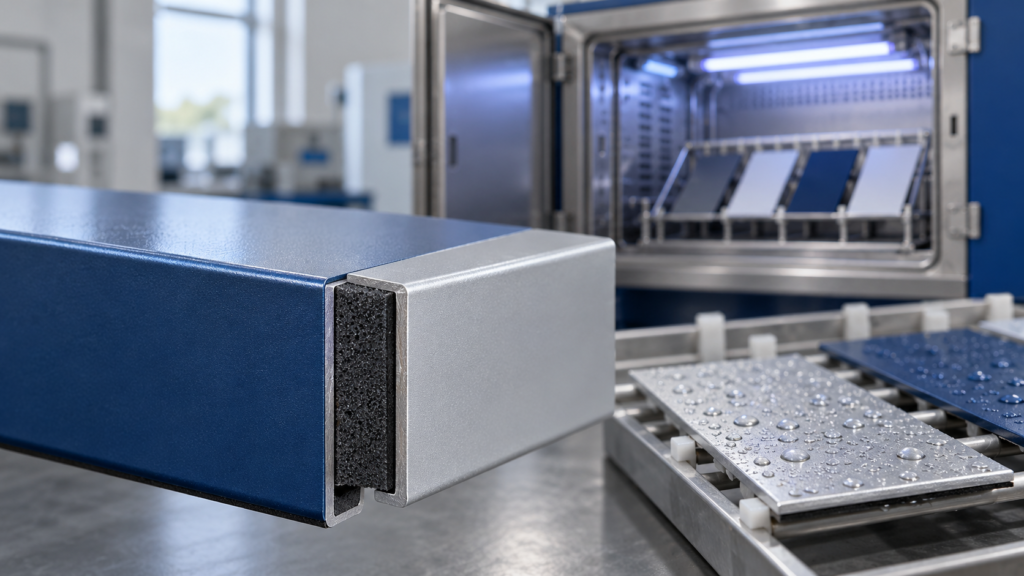
Define the actual exposure, joint design, substrates and acceptance criteria, then test the selected construction on representative assemblies.
figures and test-method references in this guide are for preliminary selection only. Final performance depends on the exact construction, thickness, substrate, application and test method; request the report for the proposed grade before approval.
Outdoor mounting tape for a panel should not be approved from a label or a generic “weather-resistant” claim. If you are deciding how to qualify tape for outdoor panel mounting, define the actual exposure, joint design, substrates and acceptance criteria, then test the selected construction on representative assemblies. Accelerated weathering can compare or screen materials under a specified exposure, but it does not by itself establish years of service for a different product or joint.
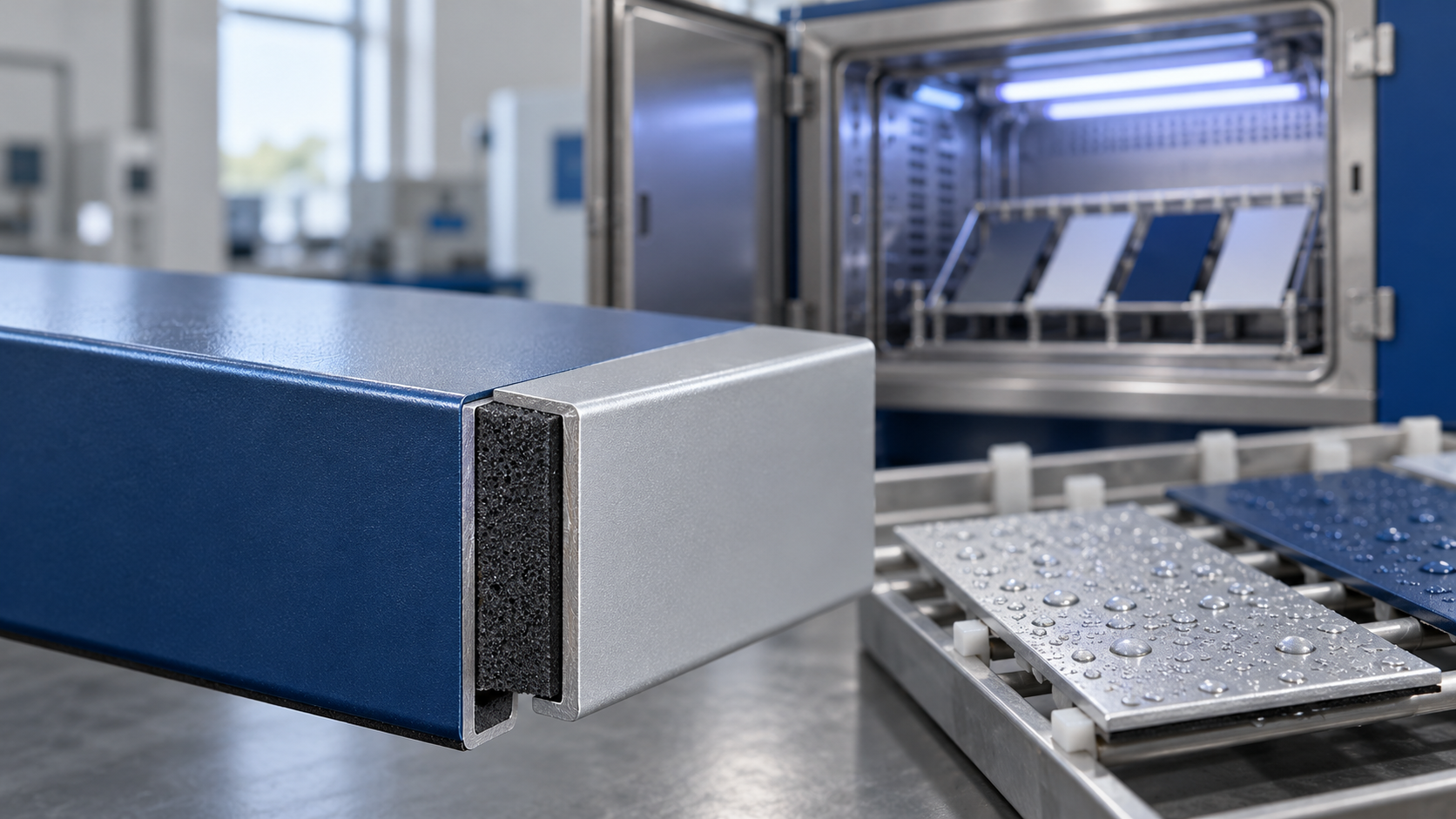
Start with the assembly that has to stay attached
“Outdoor mounting” covers very different joints. A small nameplate on a rigid enclosure, a wide sign panel, and a trim part attached to a flexible housing do not put the same stresses on tape. Before comparing constructions, write down what the bond must do: carry a sustained load, resist edge peel, accommodate panel movement, damp vibration, close a gap, or perform several functions at once.
Record both adherends separately. Include the metal or polymer, paint or coating, surface texture, cleaning process, and any release agent or process residue. A product that bonds to bare aluminum may behave differently on a powder-coated panel or a low-surface-energy plastic. If the finish changes between suppliers or production lines, include that variation in the sample set rather than treating “painted metal” as one controlled surface. The acrylic foam tape for signage guide covers the application context; this article focuses on how to qualify the joint.
The joint drawing matters as much as the tape family. Capture bond width and length, edge distance, overlap, local gaps, fastener locations, panel stiffness and tolerance range. Note which side of the joint sees peel, shear or compression. For long panels, estimate the relative movement caused by temperature change and identify where the movement concentrates. These details narrow the candidate list before a weather test begins.
Turn “outdoor” into an exposure profile
Do not specify a test as “UV and weather” without describing the service environment. Identify whether the joint sees direct sun or shade, its orientation, the expected wetting and drying pattern, standing water or drainage, temperature extremes, and how often the assembly heats and cools. Add chemicals, salt, cleaning agents or abrasion only when they are part of the real service condition.
UV, moisture and temperature cycling can affect different parts of a joint. tesa’s weather-sensitivity overview also treats sunlight, moisture and temperature fluctuations as distinct environmental factors. The adhesive may lose contact at an edge, the foam may compress or recover differently, and the substrate coating may become the weak interface. A single exposure test may not represent the order in which these conditions occur in service. Decide whether the test should combine exposures or run them in a defined sequence, and record the reasoning.
The current LubandArt acrylic foam tape product page describes a customizable construction and asks buyers to match it to the substrate and application environment. That makes it a relevant product route for panel and sign mounting, not proof that every grade meets a particular UV rating or outdoor life. For joints whose main job is cushioning or gap sealing, compare the design with the PE foam tape range; a closed-cell foam core alone does not establish the water-ingress performance of the assembled joint.
Select a test method for the question you need to answer
ASTM D5105-05R19 describes an accelerated outdoor-weathering exposure practice for pressure-sensitive tapes using concentrated natural sunlight. It describes how samples are exposed; it does not set the pass/fail threshold for an OEM panel assembly. The test plan still needs to state what will be measured after exposure and what is acceptable.
A manufacturer’s durability program can help identify useful evaluation dimensions without supplying transferable product claims. For example, 3M’s VHB durability bulletin discusses moisture resistance, accelerated and outdoor weathering, thermal cycling and fatigue. Those results apply to the products and conditions in that bulletin. They do not qualify a different tape construction or replace testing on your substrates and geometry.
For UV and moisture durability of pressure-sensitive tape, the useful output is a test specification rather than a borrowed number. State the exposure method and edition, specimen preparation, duration or UV dose, temperature and humidity profile, conditioning time, and whether the whole joint or only tape coupons are exposed. Record the loading method and the inspection points. If an accelerated method is used, treat it as a controlled comparison unless the project has a validated correlation to field service for the same materials and design.
Define acceptance before samples go into the chamber
Choose measurements that map to the assembly’s failure risk. A panel that must remain attached may need a post-exposure load or shear test; a weather seal may need a leakage test; a decorative trim part may need an edge-lift limit and visual inspection. Where movement is expected, measure displacement or bond-line change. Inspect both the adhesive interface and the foam or substrate for cohesive failure, edge lift, cracking, residue or coating separation.
Set the pass criterion before seeing the result. “No obvious failure” is difficult to reproduce. Use a stated load, exposure, sample count, measurement point and allowable change. Include an unexposed control and enough replicates to distinguish a consistent result from a single good specimen. If the joint has a safety or regulatory consequence, have the responsible engineer define the acceptance threshold; a blog guide cannot supply that project-specific value.
Application controls belong in the same plan. Record surface preparation, application pressure, tape and substrate temperature, dwell time before exposure, and the method used to apply the part. The surface preparation and bond-strength guide explains why contact and process conditions affect pressure-sensitive adhesive bonding. A candidate tested with a different cleaning or pressure process has not been qualified for the production line you are approving.
Compare the right foam construction for the function
Acrylic foam tape is commonly considered for panel and sign attachment where the design calls for a conformable foam bond line. PE foam constructions may be more relevant when cushioning, gap filling or sealing is central. These are starting points for screening, not universal material rankings. Thickness, adhesive system, liner, substrate and joint geometry all change the result.
If the joint is intended to prevent water ingress, evaluate the assembled panel, including overlap, compression, corners, fasteners and drainage. Closed-cell foam or an “outdoor” product description does not prove an IP rating or leak-tight joint. Use the required ingress test on the actual assembly and agree on the test conditions with the customer or design authority.
If the project uses a removable panel or a flexible substrate, the answer may change again. A construction that handles a static sign may not tolerate repeated removal, bending or concentrated peel at a corner. Those are reasons to adjust the geometry, add mechanical support, or choose a different construction—not reasons to increase tape width blindly.
Put the approval decision into the RFQ
A useful RFQ gives a supplier enough information to propose a sample that can be tested meaningfully. Include the incumbent or preferred construction if one exists, substrate and finish on each side, drawing and tolerances, load direction, expected movement, environmental profile, application process, and the required post-exposure checks. Specify whether you need jumbo rolls, converted rolls or die-cut parts, because converting can affect liner handling and placement consistency.
Ask the supplier to identify which proposed grade and technical document apply to the sample, and to separate published product data from project test results. Request the test report for the exact proposed construction when making a grade approval decision. If the grade changes, the report does not automatically transfer.
The approval decision is therefore conditional: select a candidate that fits the joint function and production constraints, then accept it only when the representative assembly passes the defined exposure and post-test criteria. For a grade-specific review, send the drawing, substrate finishes, exposure profile and acceptance method through the inquiry form. That is enough to begin a sample plan without pretending a catalog description guarantees outdoor service life.
Frequently Asked Questions
Does closed-cell foam tape automatically make an outdoor joint waterproof?
No. The assembled joint must pass its specified ingress or leakage test; compression, corners, substrate, adhesive interface and installation affect the result.
Can an accelerated weathering result prove a specific number of outdoor service years?
Not by itself. Treat it as a controlled exposure or comparison unless a validated correlation exists for the same materials, joint design and service conditions.
Should the test use tape coupons or a finished panel assembly?
Use coupons for screening when useful, then verify the intended function on representative assemblies with the production substrates, geometry and application process.
What information should an OEM send for a sample plan?
Provide both substrate finishes, joint drawing and tolerance range, load and movement, exposure profile, application process and post-exposure acceptance criteria.
Send the panel drawing, substrate finishes, service exposure and required post-test acceptance criteria to request a grade-specific sample plan.
Request a quote · [email protected] · WhatsApp +86 180 6469 2463
Need this construction for a production run?
Get a quote