
Can foam tape isolate machine vibration, and what must be measured before specifying it?
Foam tape may be evaluated as an attachment or cushioning interface; approve it as an isolator only after a representative assembly passes the buyer’s vibration-response and durability criteria.
Preliminary application guidance only. No grade-specific LubandArt dynamic properties or qualified isolation design were reviewed. ISO references provide test-planning context and are not product approval; 3M mechanisms and performance remain 3M-specific.
A machine builder may add PE or EVA foam tape under a cover, panel, bracket or small component to cushion contact or keep parts from rattling. That does not establish that the tape is a vibration isolator. The practical question is whether the proposed interface changes vibration at the receiver in the required operating range without causing movement, creep, bond failure or unacceptable alignment. A foam layer can be a candidate interface, but the assembly—not the material name—must pass the buyer’s measurement and durability criteria.
Start by separating three functions. Attachment holds parts together. Cushioning limits hard contact or absorbs local impact. Vibration isolation seeks to reduce transmitted motion or force over a defined frequency range. Damping dissipates energy in a structure or layer and is not automatically the same as isolating the whole machine. One tape interface may contribute to more than one function, but a product page listing “vibration control” or “shock absorption” is not a grade-specific transmissibility curve, dynamic stiffness dataset or mount design.
The LubandArt PE foam tape page and EVA foam tape page describe product families and cushioning or vibration-related applications. The machinery application page associates foam tape with vibration isolation mounts. Those are application routes, not a qualification for a particular machine, load, frequency or foam grade. Current public pages do not provide the dynamic properties or assembly measurements needed to approve a tape layer as an isolator.
Define the source, receiver and requirement
Before requesting a sample, identify what is vibrating and what must be protected. Record the machine or source, the attached component or receiver, the location of the proposed tape, the mass carried by the interface, the number and footprint of contact areas, fastening points, and the load direction. A cover that only needs to stop metal-to-metal contact has a different acceptance target from a sensor bracket whose motion must be reduced relative to a chassis.
Describe the operating condition in a way the test engineer can reproduce: speed or excitation range, dominant operating states, start-up and shutdown, direction of motion, temperature, nearby fluids or cleaners, dust, and exposure duration. Include static compression and any shock or handling loads. If frequency content or transmitted motion is unknown, measure the baseline machine first. Do not select a foam thickness by feel and assume that it will isolate the system.
ISO 2017-1 is a framework for exchanging information between users, manufacturers and suppliers about vibration sources, receivers and the application of resilient isolation systems. It is useful as a prompt for the information to share; it does not certify a tape or approve this design. ISO 18437-3 describes a laboratory method for measuring dynamic mechanical properties of visco-elastic materials using a cantilever shear beam. Such material data can inform a design, but it does not replace a test of the actual machine assembly and does not establish properties for an untested LubandArt grade.
Test the proposed interface on the real assembly
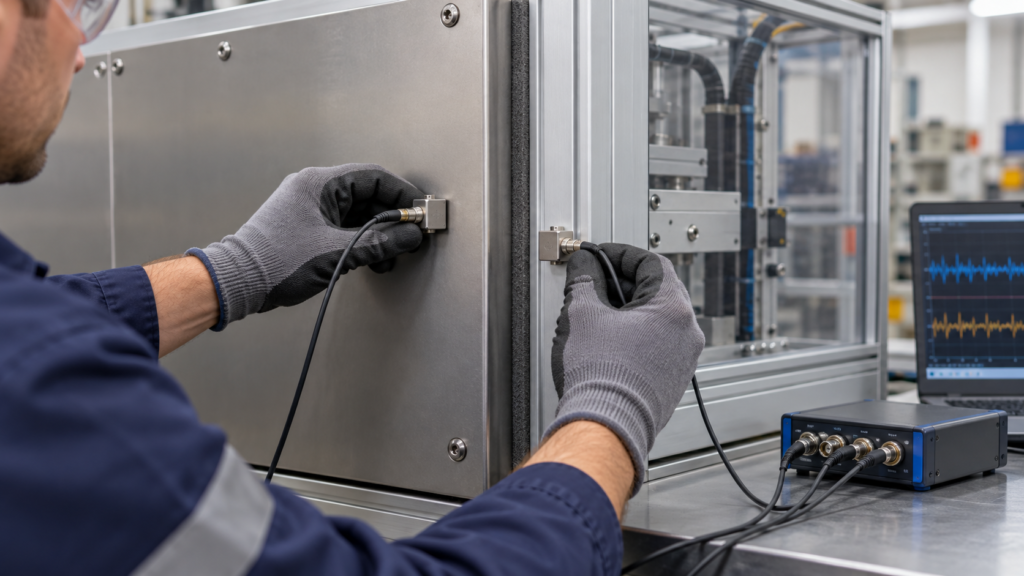
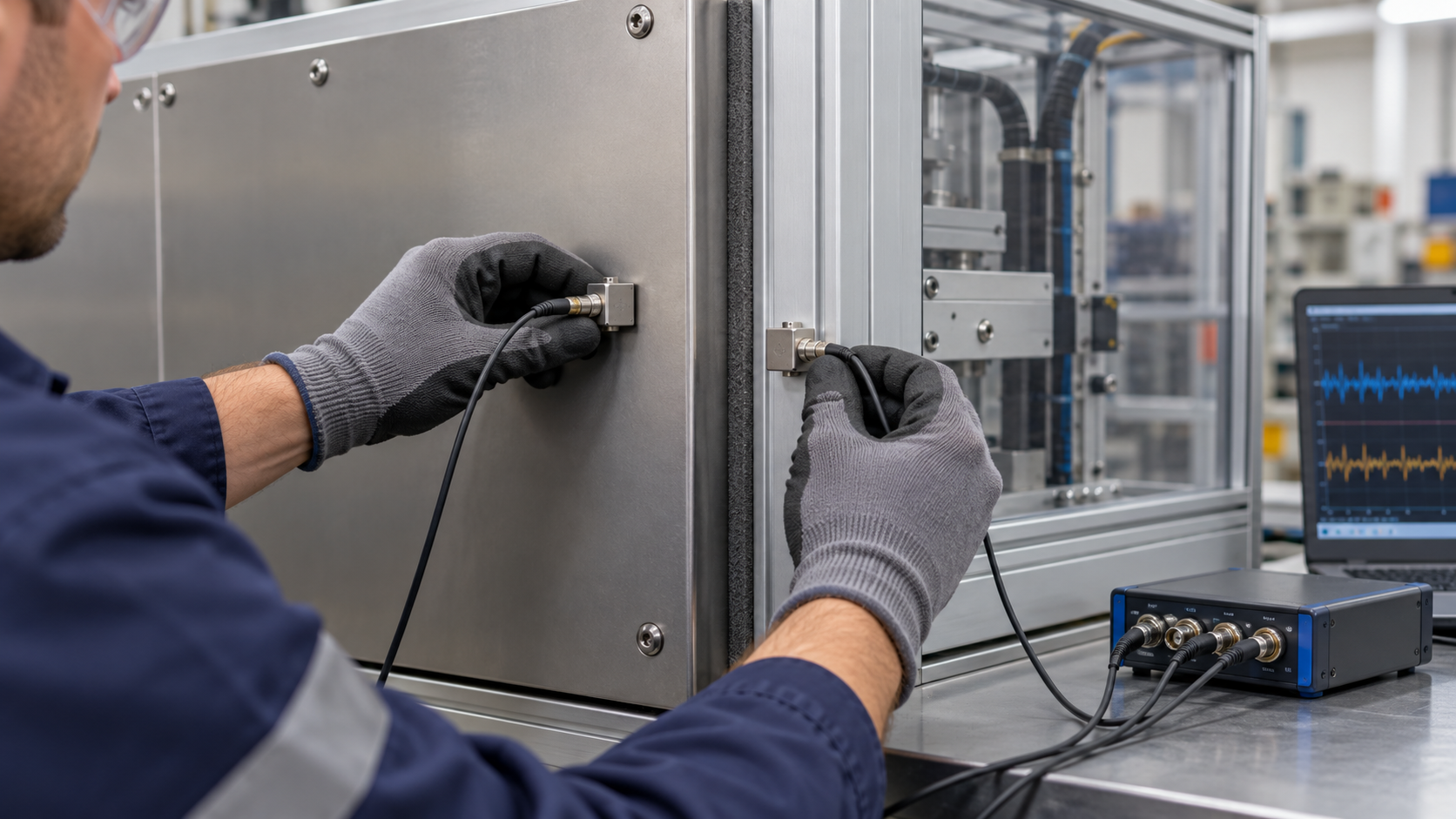
Build a representative assembly with production-intent panels, surface finishes, fasteners, tape area, thickness, liner removal and application pressure. Prepare control specimens without the proposed tape and record the baseline response. If possible, measure motion at both the source side and receiver side using accelerometers or another suitable measurement method. Keep sensor locations, mounting, machine settings and operating conditions consistent between baseline and candidate tests.
Compare frequency response or transmissibility across the buyer’s operating range, not just one convenient point. A soft layer may reduce transmission in some conditions but allow excessive displacement, shift alignment, or amplify motion near a resonance. A layer that feels compliant while unloaded may behave differently under static compression. If the tape is intended to damp a vibrating panel, the layer’s placement and constraint matter: damping materials work through their construction and interaction with the vibrating structure. 3M’s constrained-layer damping explanation is an example of a supplier-specific mechanism; do not transfer its construction, values or product results to a different tape or assembly.
Measure the outcomes that decide the application. These can include receiver acceleration or displacement, noise if it is part of the requirement, relative movement, fastener loosening, panel contact, position drift, adhesive edge lift, cohesive failure and change after conditioning. Set pass limits before the test. Repeat at representative load and temperature conditions and after a suitable duration or cycling sequence. If the required reduction cannot be measured reliably, the requirement is not yet testable and should be clarified before choosing a grade.
Check bond durability and compression effects
A vibration test immediately after assembly is not enough if the interface remains compressed or sees heat, oil mist, cleaning chemicals or repeated service cycles. Inspect foam thickness recovery, compression set, creep, bond integrity and movement after the buyer-defined conditioning. Check whether the load is carried in compression, shear or peel; the same tape construction may behave differently when the load path changes. Do not assume that adhesive holding strength alone predicts long-term isolation or dimensional stability.
Ask the supplier for the proposed grade’s current technical data, available dynamic-property evidence, thickness and density tolerances, temperature limits, compression information, and test reports that match the material and loading mode. If grade-specific data are unavailable, treat the tape as an application candidate and make assembly-level testing the release gate. A different mount design or a purpose-designed elastomeric isolator may be more appropriate when the requirement needs characterized dynamic properties or controlled deflection.
Make the RFQ answerable
Send a drawing or photos of the interface, source and receiver identification, component mass, tape footprint, proposed thickness, contact surfaces, fastener and load path, operating-speed or frequency range, vibration directions, static compression, environmental exposures, service life, and the measurement method and pass limits. State whether the goal is attachment, cushioning, rattle prevention, panel damping or measured isolation. Ask for the exact proposed grade and construction, the available dynamic data, and a representative sample for the actual assembly trial.
The answer is therefore conditional: foam tape can be evaluated as a cushioning or attachment interface, and may be considered for a vibration-related application, but it should only be called an isolator for a specific use after the required assembly-level response and durability criteria pass. LubandArt’s PE and EVA pages support starting a project discussion; they do not publish a validated isolator design. Share the machine conditions and measurement target through the contact page to scope a project-specific sample or technical review.
Identify source and receiver, mass, geometry, load direction, static compression, frequency range and environment.
Compare representative baseline and candidate assemblies with consistent sensor locations and operating conditions across the buyer-defined range.
Inspect bond integrity, creep, compression set, alignment and response after buyer-defined conditioning.
Include drawing, load, operating range, environment, target measurement, sample plan and acceptance limits.
Foam tape vibration isolation machinery requires a defined source, receiver and measured operating range; this is an application framework, not a grade approval. Foam tape may be evaluated as an attachment or cushioning interface; approve it as an isolator only after a representative assembly passes the buyer’s vibration-response and durability criteria.
is a framework for exchanging information between users, manufacturers and suppliers about vibration sources, receivers and the application of resilient isolation systems.
describes a laboratory method for measuring dynamic mechanical properties of visco-elastic materials using a cantilever shear beam.
is an example of a supplier-specific mechanism; do not transfer its construction, values or product results to a different tape or assembly.
describe product families and cushioning or vibration-related applications.
Foam tape vibration isolation for machinery is not a generic product rating; it is a buyer-defined assembly requirement that must be measured on the intended equipment.
Frequently Asked Questions
Does a foam tape product page prove vibration isolation?
No. An application association is not grade-specific dynamic-property data or an assembly test. Define the machine requirement and verify the actual assembly.
Is vibration damping the same as vibration isolation?
No. Damping dissipates energy in a structure or layer; isolation concerns transmitted motion or force between a source and receiver over a defined range. A design may involve both, but the functions need separate criteria.
What should be measured before approving foam tape for a machine mount?
Measure the representative source and receiver response with and without the proposed interface under the buyer-defined operating range, then inspect movement, bond integrity and post-conditioning durability against agreed limits.
Send the machine drawing, source/receiver, mass, proposed interface, operating range, environment, target metric and acceptance limits for a project-specific sample/test discussion.
Request a quote · [email protected] · WhatsApp +86 180 6469 2463
Need this construction for a production run?
Get a quote