
figures and test-method references in this guide are for preliminary selection only. Final performance depends on the exact construction, thickness, substrate, application and test method; request the report for the proposed grade before approval.
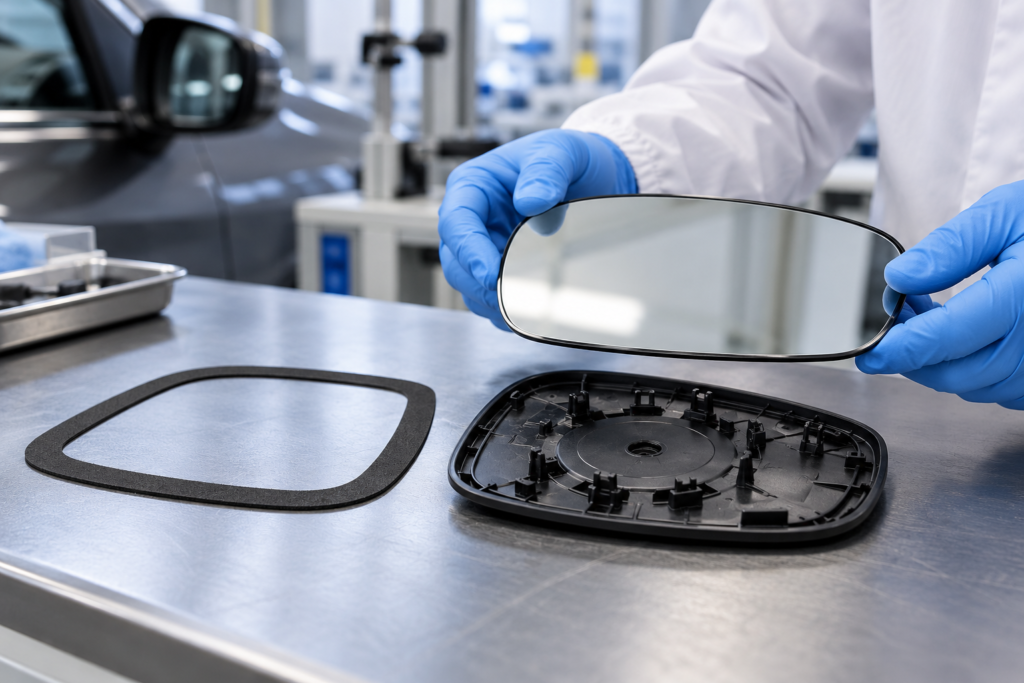
For mirror glass bonded to its base plate, the OEM should confirm the surface pair, bond footprint, assembly process and service profile for the proposed double-sided foam tape before approving a grade. LubandArt lists automotive mirror glass-to-housing as an application and offers acrylic and PE foam tape routes; its pages do not provide a grade-specific mirror approval or a universal pass limit.
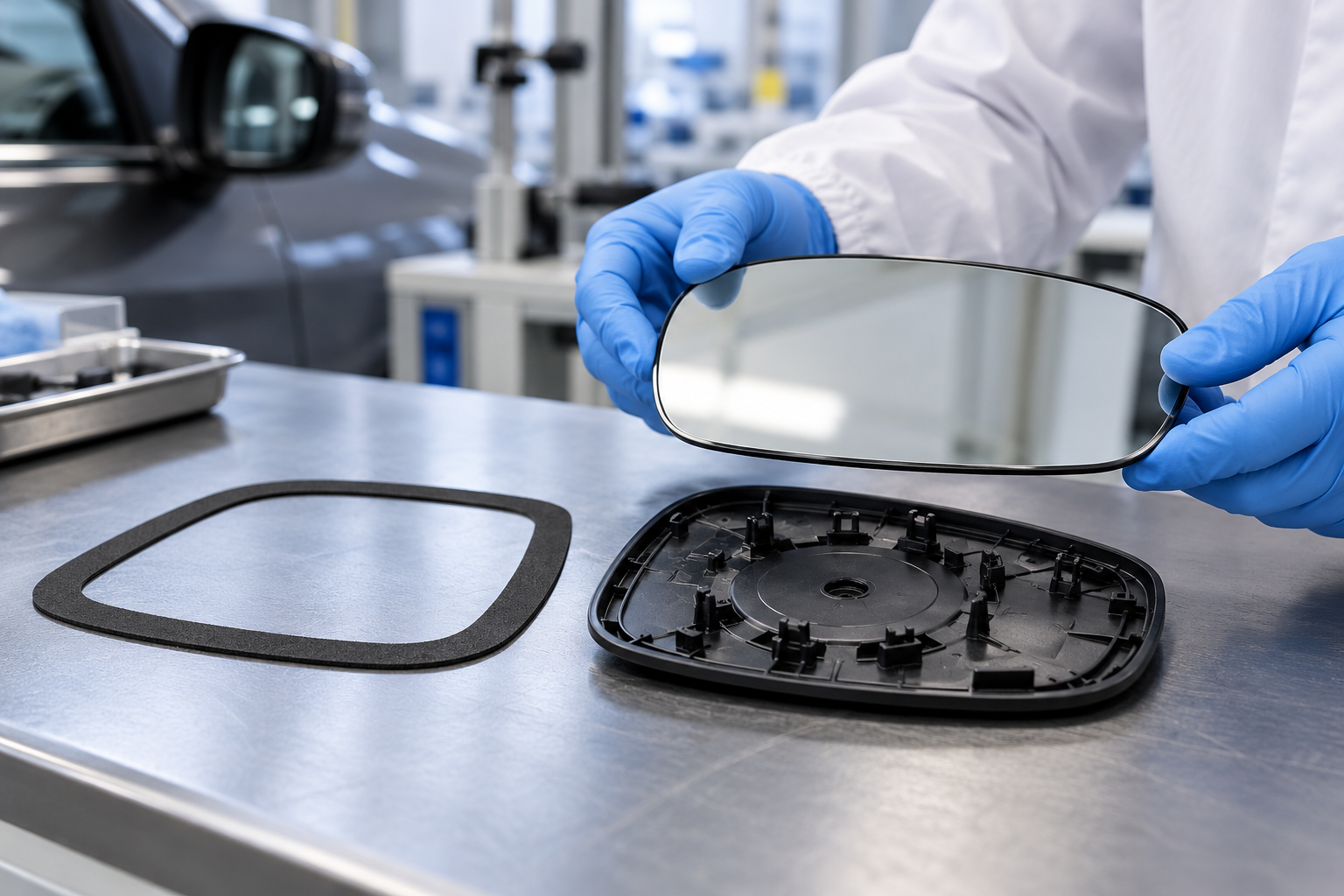
The first decision is to identify which mirror joint is being designed. This guide covers exterior mirror glass bonded to its base plate or housing. It does not cover a rear-view mirror button or bracket bonded to windshield glass. Those systems can use a different structural bonding process: 3M describes its mirror-button system as pressure-sensitive tape applied to the hardware and then heat-cured to bond it to automotive glass. That is a distinct architecture, not a grade recommendation for a foam tape between mirror glass and base plate.
Define the joint before comparing tape grades
Write down the two surfaces that the tape must join. “Glass to plastic” is not enough for an approval record. Identify the glass side that contacts the adhesive and whether it carries a coating, printed border, heating element or electrochromic feature. Identify the base plate or housing resin, surface finish, texture, molding history and any coating. If these details are unknown, the sample result cannot be tied confidently to a production assembly.
Next define the bonded shape. Record the usable land, tape width and path, corner geometry, cut-out locations, glass curvature and base-plate curvature. Include the tolerance stack for both parts and the amount of gap or mismatch the assembly must accommodate. A tape that appears to wet out on a flat coupon may behave differently around a curved perimeter, narrow land or locally raised feature. Do not assume that a thicker foam automatically solves poor contact; thickness, compression, adhesive and geometry interact and must be checked in the actual construction.
The mirror’s mass and features also affect the decision. Note whether it is heated, electrochromic, large, highly curved or used on a truck or bus, and whether wiring or other attached components load the bonded joint. These are not interchangeable use cases. tesa’s product information for its named 66108 PE foam tape specifically describes mounting automotive exterior mirror glass to a base plate, including examples involving electrochromic mirrors and larger curved commercial-vehicle mirrors. Those details show why designers should capture mirror configuration and curvature; the tesa dimensions and performance statements apply to that product only and must not be transferred to another supplier’s grade.
Select a construction to trial, not a label to approve
Acrylic foam and PE foam are product-family descriptions, not complete mirror-bond specifications. Compare the exact adhesive faces, foam carrier, thickness, density or compressibility where available, liner, converting format and die-cut geometry. LubandArt’s acrylic foam page lists glass and selected plastics among suitable substrate families and says final suitability is confirmed against the project specification and sample test. Its automotive page names rearview mirror glass-to-housing as an application and lists acrylic and PE foam tape routes. Together these pages establish a relevant supplier conversation, not proof that a particular grade has passed an OEM mirror validation.
For each candidate, ask the supplier to identify the proposed construction and the evidence available for those exact materials. A generic family sheet or a competitor’s data sheet does not establish adhesion to the buyer’s coated glass or molded resin. If a product specification lists typical values, preserve the test method, substrate, dwell and conditioning context. Do not rank values gathered under different conditions as though they were directly comparable.
There is a useful distinction between design fit and adhesion fit. Design fit asks whether the tape can occupy the available land, follow the part curvature, accommodate the approved tolerance and avoid interference with clips, heaters or wiring. Adhesion fit asks whether the selected adhesive faces bond to the actual surfaces after the agreed preparation and assembly steps. A candidate must satisfy both; passing a flat peel coupon does not settle a geometry or assembly problem.
Build a representative sample and process plan
Use parts or coupons that reproduce the production surfaces as closely as practical. Record the glass supplier and coating or print condition, base-plate resin and finish, cleaning or treatment process, tape lot, roll or die-cut format, application side and liner. If production parts are unavailable, document what the coupon does not reproduce. A polished laboratory coupon can produce a misleadingly clean result compared with a molded, coated or handled production component.
Control the application sequence. Record how the tape is positioned, how the liner is removed, the pressure or fixture used to establish contact, the time between application and mating, the assembly pressure, and the dwell or conditioning period before testing. If an automated or semi-automated placement process is planned, include alignment tolerance, cycle time and operator or equipment variation in the trial. The purpose is not to copy a supplier’s general application setting; it is to make the buyer’s own approved process repeatable.
A useful trial separates interface failure from process failure. Inspect whether the tape contacts the full intended land, whether edges lift during assembly, whether a gap or wrinkle forms, and whether any part feature prevents uniform pressure. Photograph the assembly at the same locations before and after conditioning. If a sample fails, record the failure surface and location rather than reporting only “adhesion poor.” Adhesive remaining on one side, cohesive splitting, glass-side release and edge lift point to different follow-up questions, though none alone proves the root cause.
Test the service profile that the mirror will see
Set the exposure plan from the vehicle program and the mirror’s installed location. Relevant conditions may include hot and cold storage or service, humidity, water exposure or washing, UV exposure, vibration and mechanical shock. The OEM must decide which sequence, duration, sample count and functional checks represent its use case. There is no universal mirror-tape test schedule or pass value established by the public LubandArt product pages.
Evaluate the assembly before and after the selected exposures. Look for edge lift, movement, loss of contact, visible residue or changes that affect the mirror’s functional position. Where the assembly includes heating or electrochromic functions, verify the functions and wiring clearances after conditioning. If the mirror mass, curvature or vehicle class changes, treat that as a new qualification condition unless the engineering team has justified equivalence.
A manufacturer example can help reveal variables, but it cannot substitute for the buyer’s test plan. The tesa 66108 document lists cold-shock, UV, humidity and temperature-related information for its own construction and scope. 3M’s mirror-button structural bonding page describes a pressure-sensitive application followed by heat cure for its hardware-to-windshield system. 3M also lists its 4492B PE foam tape for automotive mirror bonding, but that use statement is specific to 4492B. None of these sources proves that a LubandArt foam tape will pass the buyer’s mirror assembly requirements. Use them to distinguish application architectures and formulate questions, then validate the proposed tape itself.
Decide what the result means before the trial
Before testing, agree what constitutes a pass, a failure and a retest. Tie the criteria to the drawing, vehicle program, functional requirement or documented customer agreement. Define the sample count and lots, surface preparation, application process, conditioning, inspection points and any destructive test. If a sample fails, decide whether the next step is to change the construction, correct the process, modify the bonded land or request more evidence. Changing several factors at once makes the result difficult to interpret.
| Observation | What it establishes | Next decision |
|---|---|---|
| Tape does not fit the available land or bridge the approved geometry | The candidate may be incompatible with the design envelope | Review thickness, die-cut path, land or tolerance before making an adhesion claim |
| Bond is incomplete before environmental conditioning | The interface or application process is not ready for service testing | Review surface condition, contact pressure, alignment and exact construction |
| Assembly passes initial checks but moves or lifts after exposure | The selected construction/process has not met that defined service profile | Inspect failure location and agree a revised candidate or process trial |
| Coupon passes but production mirror assembly varies | The coupon did not represent the production interface or process sufficiently | Rebuild the trial around production parts, equipment and tolerances |
Use the result to qualify the tested construction and process combination, not every tape carrying the same family name. A change in glass coating, resin, finish, tape lot, die-cut, bonded footprint, assembly pressure or conditioning can change the conclusion. Maintain traceability from the vehicle part revision to the tape grade and sample lot so a later supplier or design change can be assessed against the same baseline.
What to send with an RFQ or sample request
Send a drawing or clear joint sketch, the glass and base-plate material descriptions, surface finishes or coatings, bonded land dimensions, curvature or tolerance information, mirror features, vehicle location and the required environmental profile. Include the planned placement method, fixture or pressure approach, production rate, sample quantity and acceptance criteria if already defined. Ask the supplier to confirm which exact construction it proposes, what relevant product-specific reports are available and what information remains unverified for your assembly.
LubandArt’s acrylic foam tape product page and automotive tape application page provide routes to discuss a candidate. For bond-interface questions, see the surface preparation and bond strength guide. These pages help start the technical review; the release decision still depends on the proposed grade and the OEM’s representative sample test.
The practical approval rule is simple: choose a candidate only after the joint geometry and both substrates are defined, and approve it only after the exact construction survives the buyer’s representative process and service-condition plan. A mirror-use label or a competitor’s product result is not an assembly qualification.
Frequently Asked Questions
Does LubandArt publish a tape grade approved for exterior mirror bonding?
The public pages identify mirror glass-to-housing as an application and show acrylic and PE foam routes, but do not publish a grade-specific mirror approval or report. Confirm the construction and validate representative parts.
Can a 3M or tesa mirror tape result approve a LubandArt grade?
No. Results apply to the named grade and conditions. They can identify design variables, but the proposed construction must be tested on the buyer’s surfaces and assembly.
Is exterior mirror glass-to-baseplate tape the same as windshield mirror-button tape?
No. A windshield mirror button bonds hardware to windshield glass and may use a heat-cured structural system. This guide covers foam tape between exterior mirror glass and its base plate or housing.
Send the joint drawing, glass/coating, base-plate material, bond land/curvature, mirror features, process and service profile to request a candidate construction and sample plan.
Request a quote · [email protected] · WhatsApp +86 180 6469 2463
Need this construction for a production run?
Get a quote