
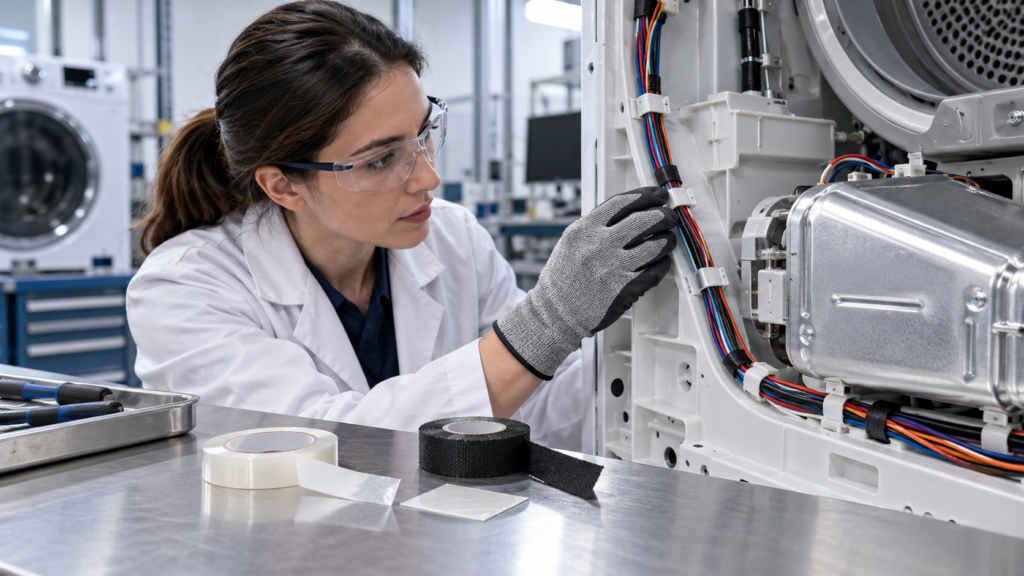
How should an appliance OEM classify wire-harness tape functions and verify evidence for electrical insulation?
Classify the tape by function, then verify exact-model evidence and end-product requirements before assigning it a safety role.
This is preliminary B2B selection guidance. UL and 3M sources describe their own categories and products; they do not certify LubandArt products. No LubandArt model is approved here for electrical insulation or live-part contact. Final suitability depends on exact model, appliance design, applicable requirements and end-product evaluation.
When an appliance design uses adhesive tape near internal wiring, the first question is what job the tape is being asked to perform. For appliance wire harness tape, classify the function before selecting a construction. A tape that holds a harness against a chassis, wraps a wire bundle, or helps shield wires from a nearby heat source is not automatically qualified to serve as electrical insulation on live parts. Classify the tape by function, then verify exact-model evidence and end-product requirements before assigning it a safety role. Release the exact tape construction only for the function and end-product conditions covered by its evidence.
That distinction matters because “PET tape,” “double-sided tape,” and “flame-retardant tape” describe material or construction features, not a complete electrical approval. The UL guidance on insulating tape testing separates insulating tapes from miscellaneous tape components, including PET and double-sided constructions. It says the miscellaneous category is not intended for electrical insulation in contact with live parts without additional suitable insulation. A flame classification such as UL 94 also answers a different question from dielectric or electrical insulation qualification.
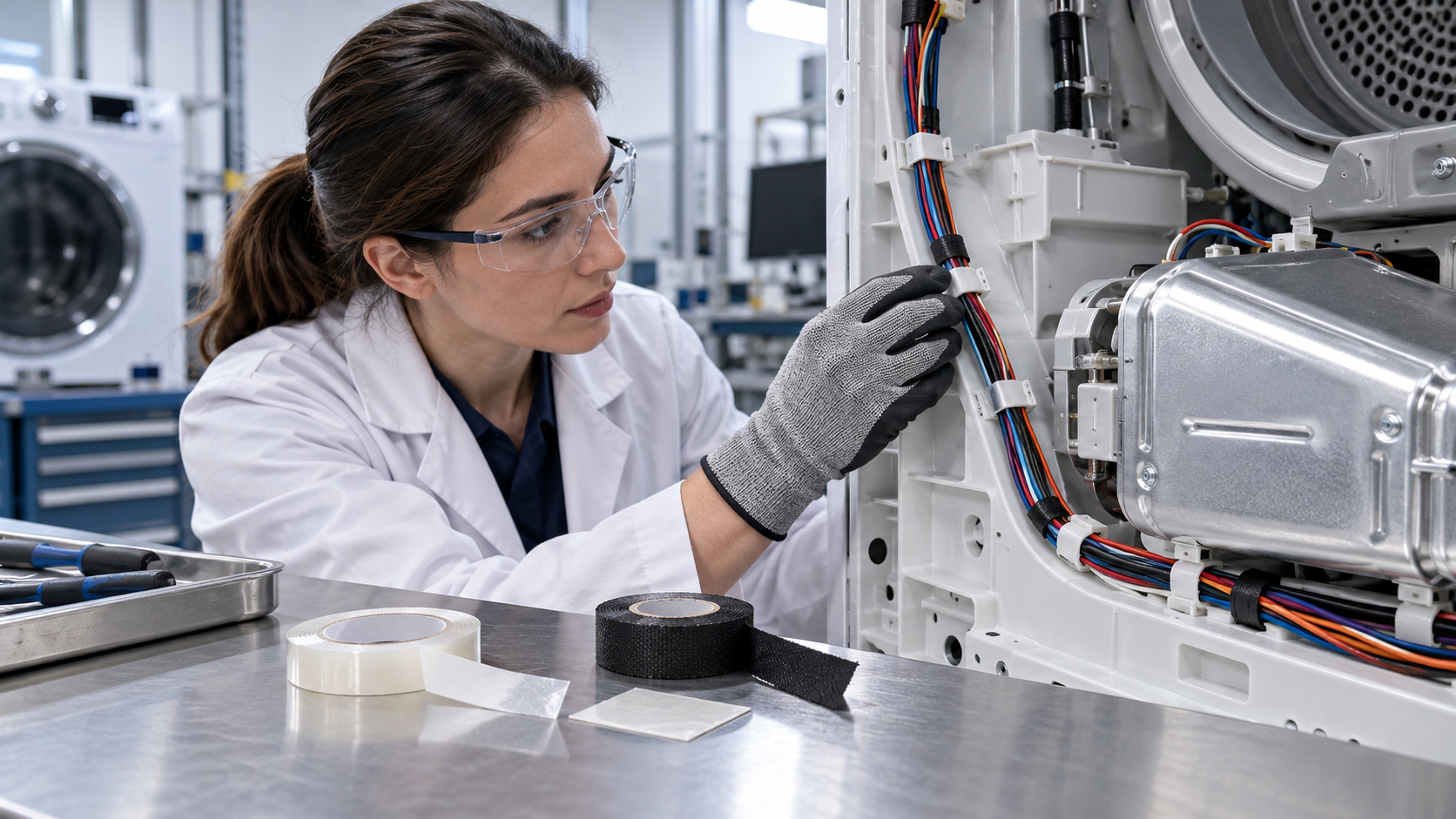
Define the function before choosing a tape family
Start with the appliance drawing and identify the tape’s role. Is it securing a wire bundle to a panel, holding wires away from a moving part, wrapping wires together, protecting a bundle near a heater, or forming part of a specified electrical insulation barrier? One assembly may contain several tape functions. Do not let a bill-of-material label such as “wire harness tape” combine them into one unreviewed requirement.
For mechanical routing or attachment, record the harness weight, movement, vibration, bend path, surface finish, contact area, nearby edges, and service temperature. The acceptance checks may include position retention, edge lift, abrasion, residue, or noise, as defined by the appliance program. For wire bundling, consider whether the tape must adhere to its own backing, conform around the bundle, or permit service access. The 3M wire attaching and bundling application profile describes those requirements for its products and gives an appliance example near a heating element. That is useful context for scoping the job; it is not performance evidence for a LubandArt grade.
If the tape is intended to provide electrical insulation, the review changes. The appliance compliance engineer must identify the electrical hazard and the applicable end-product construction: voltage and circuit conditions, whether live parts are contacted, insulation role, required separation, location, temperature, moisture, contamination, and the governing product standard or certification plan. The tape manufacturer’s component documentation must match the exact grade, thickness, backing, adhesive, color, and use conditions. The end-product manufacturer remains responsible for confirming that the assembled appliance meets its requirements.
Separate flame behavior from electrical insulation
A flame-retardant claim does not establish dielectric strength, insulation resistance, or suitability as a barrier against live parts. UL’s public information lists separate categories and evaluation paths for insulating tape and miscellaneous tape components. It identifies PET and double-sided adhesive tapes among examples of miscellaneous constructions and notes that additional suitable insulation is needed before such a component is used as electrical insulation in contact with live parts.
For a flame-retardant construction, request the test report for the precise model and thickness being considered. Confirm the material construction, conditioning, substrate, orientation, and other report details with the compliance team. Do not assume that a family name, carrier material, or a UL 94 reference automatically covers every thickness or converted part. The LubandArt product page itself states that the flame rating is per report and must be confirmed by model. That is a prompt to request the exact report, not a substitute for it.
Likewise, a PET carrier or double-sided adhesive does not prove or disprove every possible electrical use. It identifies a construction that needs to be checked against the product’s listing, recognition, conditions of acceptability, and appliance design. Do not infer a certification from appearance, material, or an application-page recommendation.
Build a model-specific evidence request
Before requesting samples, send the supplier the appliance location and assembly drawing, the exact wire and harness materials, the chassis or panel finish, the tape contact surfaces, and the function assigned to the tape. Note whether the tape touches live parts or is only a mechanical attachment. Include operating and abnormal temperature conditions, humidity or contamination exposure, expected movement, and any flame or electrical requirements from the design specification.
Ask for the technical data sheet and, where relevant, the UL file or component record for the exact construction. Review the category, model designation, thickness, backing, adhesive, color, substrate limitations, and conditions of acceptability. If the proposed part is converted, confirm that slitting, die-cutting, liner changes, or lamination do not move it outside the evaluated construction. A report for another product, thickness, or supplier cannot be transferred to the candidate.
Then define the sample plan with the appliance compliance and quality teams. A mechanical attachment trial may need to reproduce the actual wire path, panel finish, application pressure, dwell, and harness movement. An electrical insulation or flame evaluation must follow the end-product compliance plan and its specified tests. Keep those approvals separate in the record so a passing harness-retention check is not mistaken for electrical qualification.
Release only the function supported by evidence
A practical release table should identify the tape’s intended function, the exact material model, the evidence reviewed, the assembly conditions, and the responsible approval. For example, a double-sided PET tape may be evaluated as a mechanical attachment candidate if its adhesive and assembly performance pass the OEM’s trial. That result alone does not make it electrical insulation. A flame-retardant tape with a model-specific report may address a defined flammability requirement, but that report does not automatically establish electrical insulation either.
The current LubandArt appliance page associates PET and flame-retardant tape families with a wire harness application. Its PET and flame-retardant product pages describe customizable constructions and direct buyers to confirm model-specific reports and project suitability. These pages identify candidate routes, not a named electrical-insulation listing, voltage rating, or approval for live-part contact. Ask for the exact grade documentation before assigning a safety function.
If the documentation does not cover the intended function, hold the design release and ask the compliance owner what additional insulation, component evidence, or end-product test is required. Do not make a safety decision from a generic family description or a flame claim alone.
For LubandArt-specific candidate routes, review the appliance tape application page, PET tape product page, and tape with flame-retardant options product page. The guide to choosing double-sided tape gives general selection context; it does not replace model-specific safety documentation.
Frequently Asked Questions
Does flame-retardant tape automatically qualify as electrical insulation?
No. Flame classification and electrical insulation qualification address different properties. Confirm the exact tape model documentation and the appliance end-product requirements for the intended function.
Can double-sided PET tape hold an appliance wire harness?
It can be evaluated as a mechanical attachment candidate for a defined assembly. Validate the exact substrate, harness load, temperature, movement, adhesive construction and application process. Mechanical retention does not establish suitability for contact with live parts.
What should I request from the tape supplier?
Request the exact model and construction, current technical data, applicable UL listing or recognition and Conditions of Acceptability where relevant, reports for the selected thickness, and limitations for the actual substrates and service environment.
Send the appliance drawing, harness and panel details, tape function, live-part status, exact grade and compliance requirements to scope a sample and evidence review.
Request a quote · [email protected] · WhatsApp +86 180 6469 2463
Need this construction for a production run?
Get a quote