
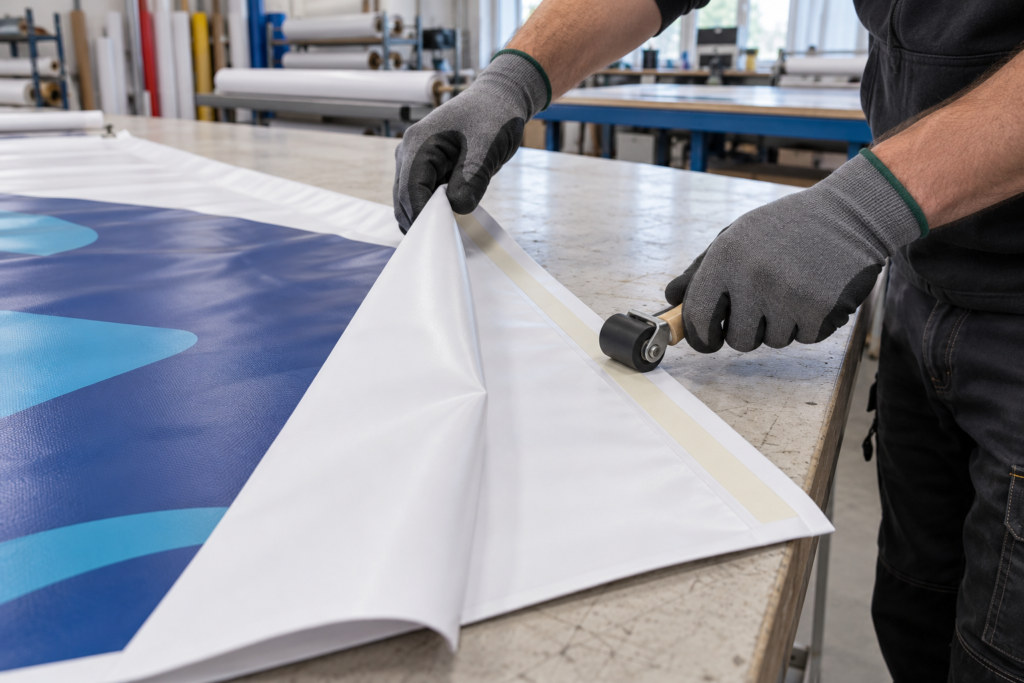
When can a double-sided tape hem be used for a printed PVC banner instead of sewing or welding?
A double-sided tape hem is a candidate for some printed PVC banners when it fits the shop’s volume and process, bonds the actual printed media stack, and the finished edge passes a defined load and exposure test.
Process and qualification guidance only. No LubandArt grade-specific banner-hem performance report was reviewed. Confirm the exact construction and test the finished edge on representative printed media before production approval.
A double-sided tape hem can be a practical finishing route for some printed PVC banners, especially when a shop needs a low-volume process without a sewing or welding station. A tape family name or closed list of adhesive options does not establish outdoor life, plasticizer resistance, or a safe load for a particular banner.
Compare finishing routes against the shop’s job volume, available equipment and the cost of rework or an edge failure. HP’s Latex finishing guide describes tape as one option for lower-volume banner finishing and sewing or welding as alternatives for other workflows. Avery Dennison’s banner guidance treats hemming tape as media-specific and discusses preparation, pressure and adhesion time. These are process references; neither approves a LubandArt tape grade.
A straight coupon cannot establish a hem’s service performance when grommets, pole pockets or installation tension create concentrated edge loads. Qualify a representative finished hem made from the actual printed and laminated media, bond face, cleaning method and cure state. An unprinted sample is representative only when the substitution is justified. Define the load and exposure acceptance criteria with the buyer before the trial.
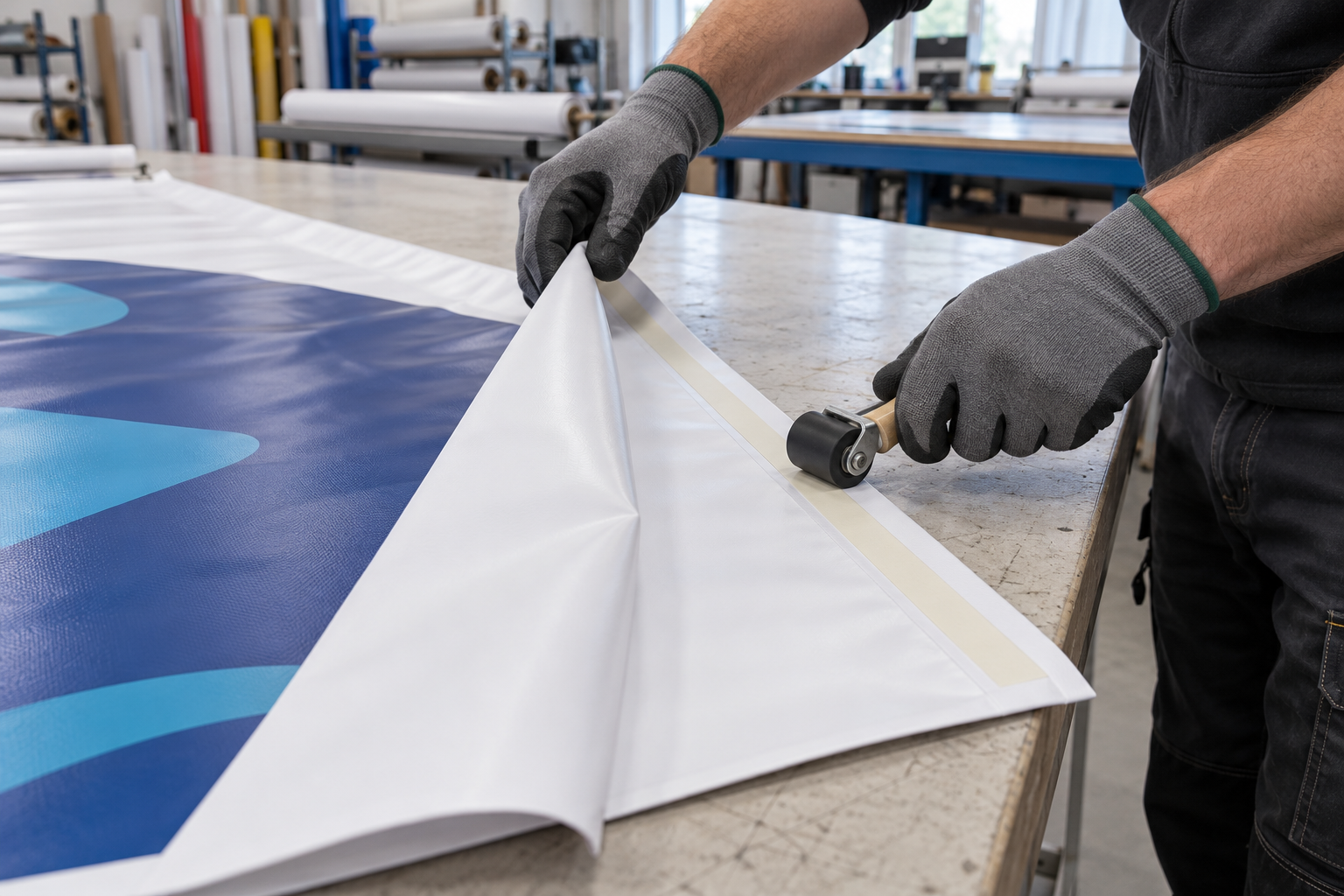
For a printed PVC banner hem, the media, print stack and finished-edge load determine whether the tape route can be qualified.
Decide whether a taped hem fits the production route
Compare tape, sewing and welding against the actual workload and installation. Taping may reduce equipment requirements for short or varied runs; sewing or welding may suit higher throughput when the shop has the equipment and the media supports the process. Include setup time, operator handling, inspection, rework and the cost of an edge failure. Treat grommets, pole pockets and tensioned installations as distinct load paths, not as a flat fold.
The decision also depends on the finished banner. A hem may carry grommets, a pole pocket, wind load, tension from a frame, or repeated handling. The load path and edge design matter. Tape that holds a flat fold in a bench trial may not be adequate around a grommet or under a tensioned installation. Treat pole pockets, panel seams, and mounting the finished banner as different constructions; this guide covers only a folded edge hem.
Identify every layer in the bond
Before selecting tape, record the banner substrate and the surface that the adhesive will contact. “PVC banner” can describe materials with different face films, scrims, coatings, plasticizer packages, surface treatments, and printed finishes. The adhesive may touch the printed face, an unprinted reverse, a laminate, or more than one layer after folding. Ink and overlaminate can change the bonding surface. A tape selected against an unprinted sample may not behave the same on the final printed and cured construction.
Record the media maker and grade, print and laminate combination, which face is bonded, cleaning method, and time between printing and hemming. Ask the media supplier whether the proposed fold and adhesive route are acceptable for that construction. If the banner maker specifies a particular hem tape or finishing method, follow that instruction unless the responsible maker approves a documented alternative.
Avery Dennison’s guidance recommends tape designed for banner hemming and discusses cleaning, firm pressure, and full-adhesion time. Those directions are useful qualification prompts, but their precise instructions apply to their stated products and media. Do not transfer them as a blanket process specification for another tape or banner.
Treat plasticizer compatibility as a grade-specific question
Plasticizer migration can affect adhesive behavior over time, so compatibility must be confirmed for the specific PVC media and adhesive construction. 3M’s surface-preparation bulletin explains that flexible PVC plasticizers can migrate into an adhesive and change adhesion; its suggested aging procedure applies to 3M products and is not a universal qualification method. An external banner-hem tape datasheet may report plasticizer resistance for its own grade and test conditions. That is evidence that the property can matter; it is not evidence that another supplier’s PET-carrier tape has the same resistance.
For a candidate grade, request current technical information for the exact construction and confirm whether it addresses the proposed PVC media, print or laminate, temperature, and exposure. If the document does not cover the application, qualify representative printed material through a controlled pilot and agreed conditioning period. Do not convert a short initial tack check into a claim of long-term compatibility.
Define a repeatable folding process
A useful trial controls the fold width, overlap, tape width and position, pressure, application speed, dwell, and surface preparation. Record ambient and material conditions. Use a roller or other specified pressure method consistently instead of relying on hand pressure that varies by operator. Keep the adhesive away from dust, skin oils, cleaning residues, and uncured print components.
Make test pieces from the actual production stack: same media lot where practical, same print and laminate, same cleaning method, and the same fold geometry. Include representative corners and cut edges if the real process creates them. Inspect whether the tape wets both surfaces, whether the fold opens at the edge, and whether adhesive squeezes out or contaminates the visible face. A clean appearance immediately after application is not a service-life result.
Set acceptance checks around the installation
Choose a test that represents the failure the buyer needs to prevent. A simple hand pull is useful for screening but is not a standardized load rating. For a more repeatable check, define specimen width, grip arrangement, pull direction and rate, conditioning, and pass/fail criterion. Where the banner will be tensioned or exposed outdoors, include representative edge loading and environmental conditioning that reflect the actual use. Agree these methods with the banner, tape, and installation stakeholders before testing.
Inspect both the bond and the media after testing. Record adhesive separation, cohesive failure, media tear, ink or laminate damage, residue, and any edge distortion. A strong adhesive can still be the wrong choice if removal damages the reusable substrate or if the banner tears beside the bond. If a hem carries grommets or concentrated loads, test that finished detail rather than extrapolating from a straight coupon.
When to choose another method
A taped hem should be held from approval when the media maker prohibits the adhesive route, the contact surface is unknown, the print or laminate is not fully ready, the banner is exposed to conditions outside the available evidence, or the intended edge load has not been defined. Sewing or welding may be more appropriate when the production equipment and media support those methods, or when the customer’s approved construction requires them. The choice should follow the media and job specification, not a universal rule that one method is always stronger.
LubandArt lists a PET carrier tape family with configurable adhesive, thickness, and converting formats. See the wider broader tape range for other carrier families. That gives a buyer a product-family route for a technical discussion; it does not establish a banner-approved SKU, plasticizer resistance, outdoor durability, or a load rating. The proposed grade must be selected and tested against the actual banner construction before production approval.
What to include in a sample request
Send the media maker and grade, print and laminate stack, which face will be bonded, hem width, tape placement, cleaning process, intended indoor or outdoor exposure, expected edge load, grommet or pole-pocket details, and the acceptance method. Ask for the exact proposed grade’s construction and applicable technical data. Run a pilot on representative printed media and retain the samples and process settings with the job record.
The practical answer is conditional: double-sided tape can be considered for a vinyl banner hem when it fits the shop’s volume and process, the exact grade is compatible with the real printed media, and the finished edge meets a defined application test. Without those checks, the tape should remain a candidate rather than an approved production method.
References
- HP Latex R Series Finishing Guide
- Avery Dennison, Tips for Creating Digitally Printed Banners
- LubandArt PET tape family
- External product-specific example, used only to identify grade-specific properties: banner hem tape datasheet
Frequently Asked Questions
Can double-sided tape replace sewing on every PVC banner?
No. Route suitability depends on the banner media instructions, printed stack, shop volume, edge design, installed load and buyer acceptance test.
Does a PET carrier mean the tape resists PVC plasticizer?
No. Plasticizer compatibility is grade- and media-specific and needs applicable test data or a representative qualification.
Should the hem test include grommets or pole pockets?
If those details are part of the installed edge, include representative finished details because they can concentrate load.
Submit the banner media maker and grade, print/laminate stack, hem geometry, exposure, edge load and acceptance method for a grade-level review and representative sample plan.
Request a quote · [email protected] · WhatsApp +86 180 6469 2463
Need this construction for a production run?
Get a quote