
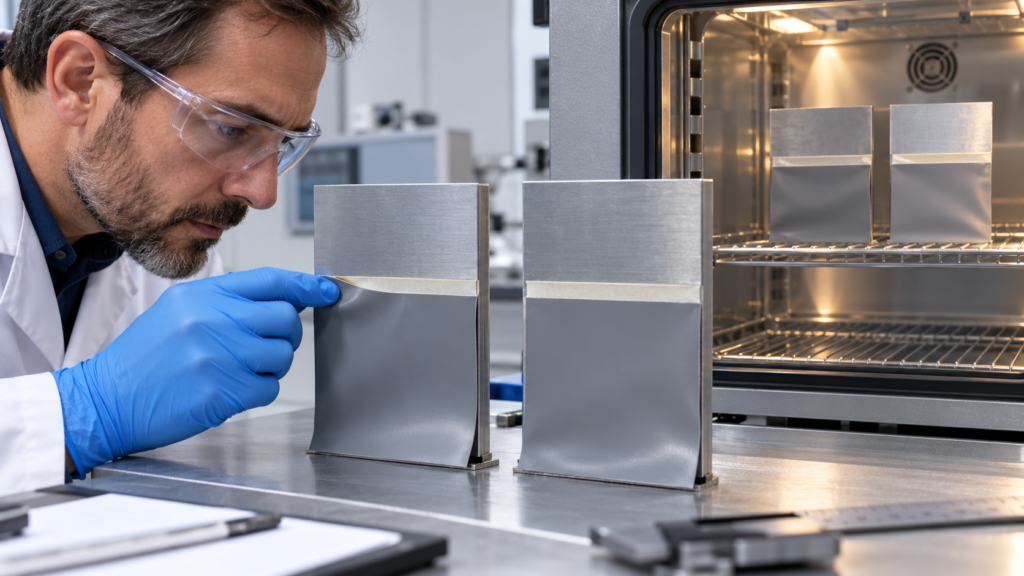
Will double-sided tape hold on flexible PVC after plasticizer migration aging?
Do not assume compatibility from a product family name; test the exact tape, vinyl formulation, mating surface, assembly process and agreed aging conditions before release.
Preliminary compatibility guidance only. No grade-specific LubandArt long-term migration-resistance report was reviewed. 3M mechanism statements and aging examples remain 3M-specific; agree the test protocol and acceptance limits for the actual project.
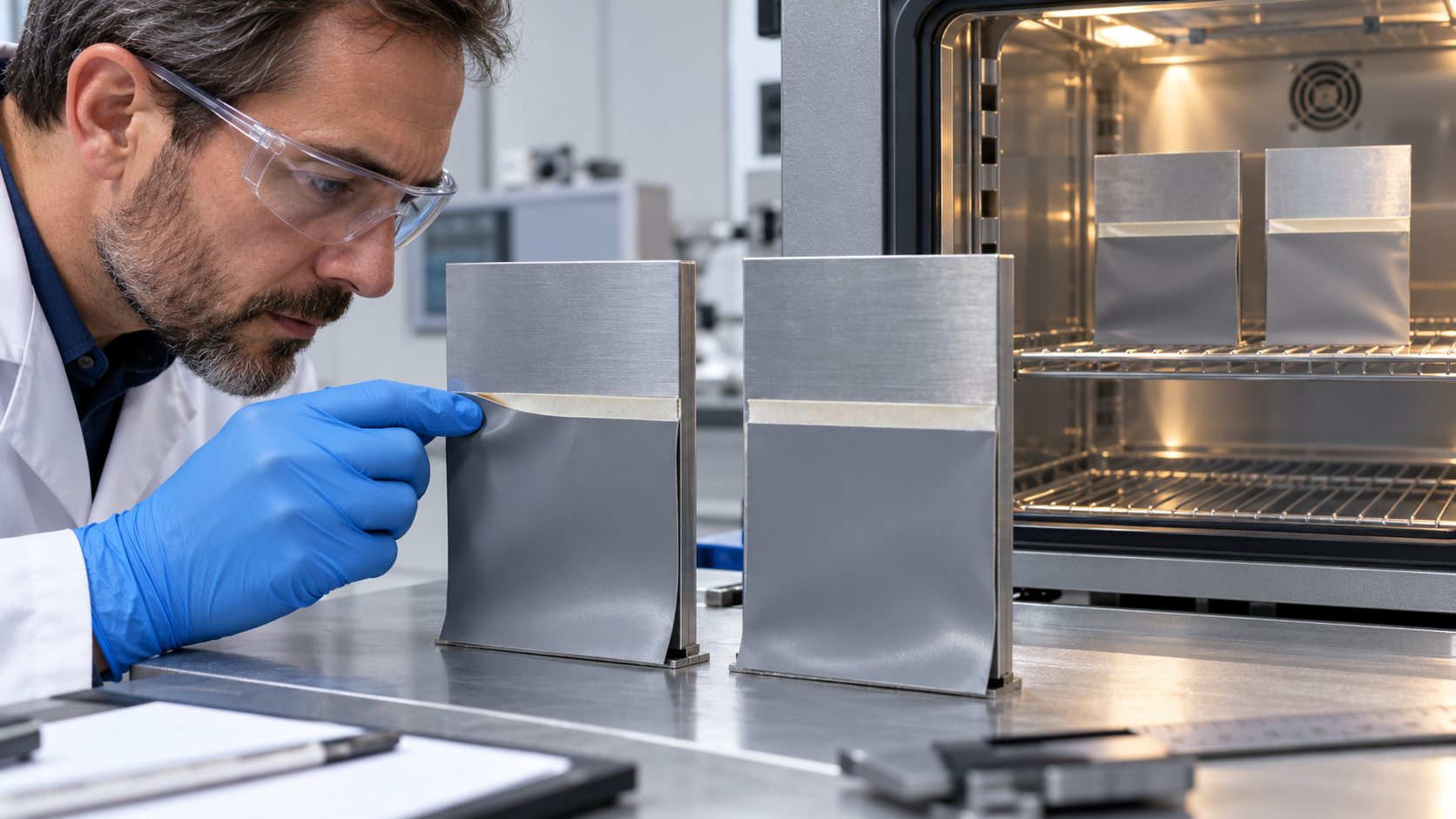
When a pressure-sensitive adhesive tape is bonded to flexible PVC or vinyl, the substrate can change after assembly. Some flexible vinyl formulations contain plasticizers that can migrate into a pressure-sensitive adhesive. Depending on the exact vinyl formulation and adhesive, this interaction may soften the adhesive and reduce bond strength over time. That creates a practical OEM decision: can the proposed tape and this specific vinyl lot retain the required bond through the intended service conditions, or should the assembly use another construction?
First separate the tape carrier from the bonded substrate. “Double-sided PVC tape” can describe a tape with a PVC film carrier and adhesive on both sides. That does not mean it is automatically compatible with a flexible PVC or vinyl surface. The buyer must identify what the tape is bonding to: the plasticized vinyl formulation, its coating or print, and the mating surface on the other side. Different vinyl compounds may use different plasticizers, additives, surface treatments and backing layers. A family-level product name cannot resolve those differences.
LubandArt’s PVC tape product page calls out plasticizer migration as a risk when bonding to flexible PVC and recommends testing the particular pair. The page supports an application discussion; it does not publish a grade-specific long-term compatibility report for every vinyl formulation. Therefore, do not approve a grade from a catalog description alone. Define the assembly and agree a representative aging trial before production release.
Identify the exact vinyl and bond stack
For the flexible PVC part, request the supplier’s material designation and revision, plasticizer type if available, surface coating or print, color, release agents or other process additives, and lot traceability. Record whether the surface is new, aged, cleaned, textured, printed or protected by a film. Include the mating substrate and its finish. “PVC to metal” or “vinyl trim” is not a sufficient test description if several formulations or finishes are used.
Map the bond geometry and load. Note the bonded area, tape thickness and width, edge exposure, bend radius, compression or tension, and whether the joint sees peel, shear or a mixed load. Specify how the tape will be applied: surface cleaning, application pressure, dwell before loading, temperature at application, and whether the vinyl is stretched or formed during assembly. A passing flat coupon cannot represent a curved edge or a joint that is continuously peeled by the part geometry.
Then describe service. Include temperature range and cycling, humidity or water exposure, UV or outdoor exposure, contact with oils or cleaners, duration, and any movement or vibration. These conditions should reflect the actual part and customer requirement. Do not assume that a competitor’s accelerated-aging schedule predicts a different adhesive and vinyl combination.
Build a controlled comparison
Use samples from the actual production-intent vinyl and mating surface, with the proposed tape grade, liner, bond area and application process. Make control specimens and test specimens. Keep preparation, pressure, dwell and conditioning consistent. If there is a current approved bond, include it as a benchmark where practical. Record material lot numbers and the exact sample construction so a result can be traced to what was tested.
Agree the aging conditions with the customer and supplier before testing. The protocol should reflect the service requirement and should define temperature, duration, cycling, humidity or chemical exposure as applicable. The 3M F9465PC technical data sheet explains that plasticizer type and amount vary between flexible vinyl formulations, that migration can soften an adhesive and reduce bond strength, and that each vinyl substrate should be tested. It also gives one accelerated-aging example for its own F9465PC adhesive. A 3M VHB surface-preparation bulletin also flags materials containing migratory components such as plasticizers as unique surfaces. These are supplier-specific references; neither schedule nor procedure is a universal LubandArt specification. That example is supplier- and product-specific; it is not a universal protocol or a LubandArt product specification.
Measure before and after aging using the agreed method. Depending on the joint, useful outputs include peel or shear retention, edge lift, adhesive transfer, cohesive softening, discoloration, ooze, creep, slip, and whether the vinyl itself tears or deforms. Inspect the bond line and failure mode, not only a peak force. If the part is curved or has exposed edges, assess the assembled shape and edge condition after conditioning. Use the same specimen dimensions and test speed for comparisons, and record any deviations.
Set acceptance criteria before the results are known. The buyer should state the minimum retained performance or acceptable failure mode, the sample count, lot coverage, and any visual limits. If requirements are not defined, the test can report measurements but cannot produce a clear approval decision. A trial that passes a convenient initial peel but loses adhesion after representative conditioning does not support a long-term release.
Decide what a result does and does not prove
A passing trial supports the tested tape grade, vinyl formulation, mating surface, process and aging conditions. It does not automatically qualify a different vinyl lot, color, plasticizer package, coating, tape construction or assembly geometry. Establish change controls for substrate or tape revisions. If the formulation changes or supplier cannot confirm equivalence, repeat the relevant compatibility review.
A failed trial should be diagnosed by interface and failure mode. Adhesive softening, adhesive transfer, edge lift, vinyl surface contamination and cohesive failure point to different questions. Review the exact adhesive, surface condition, bond area, load path, application process and conditioning. A different tape family, surface preparation or mechanical design may be worth evaluating, but no substitution should be approved without repeating the representative test. Do not infer that a product marketed for plasticizer resistance is automatically suitable for every flexible PVC.
Make the RFQ testable
When asking for a sample or technical review, include the vinyl designation and revision, plasticizer information if known, mating material and finish, drawing, bonded area, edge exposure, load direction, application pressure and dwell, service temperature and exposures, required life, test method, sample count and pass criteria. Ask the supplier to identify the exact proposed grade and construction and to provide any grade-specific compatibility or aging data available for the named substrate. Request written confirmation of the sample lot and the test scope.
The practical answer is conditional: double-sided tape may be evaluated for a flexible PVC bond, but plasticizer migration is a substrate-specific aging risk. Approve only the exact tape/vinyl assembly that meets the buyer’s agreed post-aging bond and visual criteria. LubandArt’s PVC tape page is a starting point for a project discussion, not a blanket compatibility claim. Share the vinyl specification, drawing and service conditions through the contact page so the proposed sample and test can be scoped to the actual application.
Record vinyl grade/revision/lot, plasticizer if known, coatings and print, mating surface, geometry, edge exposure and load direction.
Agree service-representative aging, controls, specimen count, test method and pre/post bond and visual criteria with the customer and supplier.
Inspect bond retention, softening, transfer, discoloration, ooze, edge lift, creep, deformation and failure mode against buyer limits.
Send substrate and drawing details, process, service exposures, test method and acceptance limits; request the exact grade and available compatibility evidence.
Double sided tape flexible PVC plasticizer migration must be evaluated for the exact vinyl and assembly. Do not assume compatibility from a product family name; test the exact tape, vinyl formulation, mating surface, assembly process and agreed aging conditions before release.
Plasticized flexible PVC tape bond qualification depends on the exact PVC formulation, adhesive construction and service conditions; it is not inferred from the word PVC in the tape name.
Frequently Asked Questions
Does double-sided PVC tape automatically bond to flexible PVC?
No. PVC carrier tape and flexible PVC substrate are different parts of the construction. Identify the exact vinyl formulation and test the tape/substrate pair.
Can another supplier’s accelerated-aging schedule be copied?
Not as a universal specification. Use competitor guidance as context only; agree aging conditions and acceptance limits for the actual service requirement and proposed grade.
What are signs of possible plasticizer-related bond failure?
Inspect for adhesive softening, bond loss, transfer, ooze, discoloration, creep and edge lift, and record peel/shear retention and failure mode against buyer-defined limits.
Send the vinyl grade/revision, mating surface, drawing, bond process, service exposures and buyer acceptance criteria for a project-specific compatibility sample review.
Request a quote · [email protected] · WhatsApp +86 180 6469 2463
Need this construction for a production run?
Get a quote