
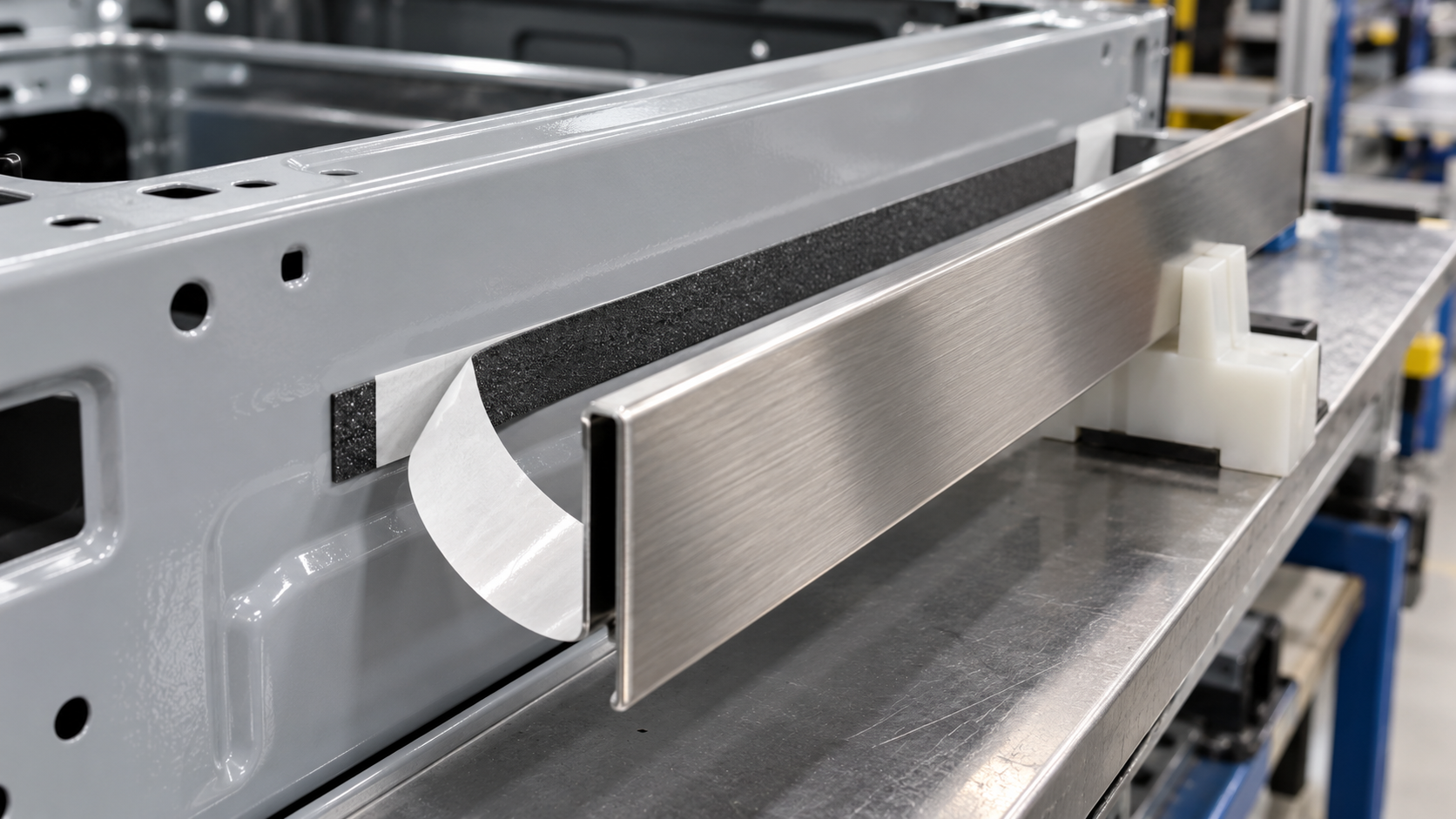
PE foam mounting tape can be the sole mount for an appliance trim only after bond area, load direction, spring-back and service exposure pass a joint-level retention test. Use clips or screws when failure consequences or peel loads demand mechanical retention. LubandArt’s PE foam product page lists appliance panel fixing and configurable adhesives, but the published page does not provide a rated allowable load for an individual grade.
Separate a mounting function from an assembly aid
The first screening question is how the load acts. A broad vertical trim with a large, continuous bond area is different from a small hook that peels away at one edge. A part with a lever arm creates peel even if its mass seems low. If failure could drop a heavy or safety-relevant part, design a mechanical retention feature and treat the tape as a positioning or damping component until the complete assembly is qualified.
Compare grade data only under matching tests
3M’s 4492B technical data sheet reports peel, tensile and static-shear results for its own black PE foam grade, each with a named substrate, dwell time and test method. Its static-shear examples also change with temperature and load. These are not allowable design stresses for LubandArt tape, and a peel value on clean stainless steel does not predict a painted plastic trim.
Use supplier data to shortlist constructions, then test the real trim and panel finish. Include the full adhesive cure or dwell period before the retention test, as reported for the proposed grade. Also test after the thermal and humidity exposure expected in use. If the trim is curved or spring-loaded, measure its residual lift force; that stored force can dominate a nominal weight calculation.
Map the load path before comparing tape grades
Draw the trim in its installed orientation and mark gravity, operator pull, cleaning forces and any spring-back from curvature. The tape sees different stress when a part tries to slide parallel to the panel than when a corner lifts away. A narrow bond line at the far side of a lever arm can concentrate peel even when the total trim mass is small. This is why a calculated area divided by weight is not, by itself, a design check. Ask whether the tape is a permanent primary mount, a locator until clips engage, or a vibration-damping layer behind a mechanically retained trim.
Define what failure means. For a decorative panel, a small visible edge gap may be unacceptable well before the trim falls off. For a retained component, loss of position may cause a rattle. For a safety-relevant part, detachment can be unacceptable under any tested condition. The pass criterion should therefore include displacement or edge lift as well as ultimate pull-off. A test that stops at “still attached” can miss the defect the buyer will actually reject.
Compare constructions on the real finishes
Prepare identical production-finish panels and trims for each candidate adhesive. Hold bond area, cleaning method, pressure and dwell constant so a difference in result can be attributed to the construction rather than application variation. Test at room condition first, then after the heat, humidity or cleaning exposure the product will see. If the trim is curved, use the real curved part, not only a flat coupon. The sustained restoring force of that part is part of the joint.
Report both the force and the failure mode. Adhesive release from painted steel suggests a surface or adhesive-side problem. Separation at the plastic face suggests a different interface. Tearing within the foam suggests the carrier is the limiting element. A clean test number without its failure location cannot tell the supplier what to change. If two candidates both meet the minimum requirement, assembly handling, liner removal and supply format can decide between them.
Keep application conditions in the process specification
Train the application step around the validated conditions. A tape applied over dust, oil or a release agent can fail even if laboratory specimens passed. Define the cleaning agent, drying step, minimum panel temperature, pressure tool and time before the line loads the trim. Make sure the chosen liner can be removed without touching the adhesive or stretching the foam. Where operators cannot reliably apply uniform pressure, a fixture may be more valuable than a nominally higher-tack tape.
At incoming inspection, confirm the grade, width, thickness and liner against the approved sample. At final assembly, check placement and any specified edge-lift limit. These controls turn a one-time engineering result into repeatable production. They also give purchasing a clear substitute policy: a different PE foam tape cannot be swapped in solely because its nominal thickness matches.
Choose an adhesive for the substrate, not the foam name
PE foam is the carrier. Adhesion comes from the coatings on its faces. tesa 64962 is an example of a PE foam tape with synthetic rubber adhesive marketed for trims and profiles; 3M 4492B uses acrylic adhesive. The two examples show why “PE foam tape” is not a single adhesive specification. They do not prove either system is best for a particular LubandArt grade or appliance finish.
Before a quote, state the two mating materials, surface treatments, available bond area, load direction, mass, temperature range and whether the tape is backed by clips or screws. Ask for a proposed construction and a joint test plan. If the tape is only an assembly aid, say so; this may allow a different, simpler construction than a permanent primary mount.
Frequently Asked Questions
Does more tape area always solve edge lifting?
No. Curvature and spring-back can create peel at one edge; test the actual trim geometry.
Can a stainless-steel peel value rate a painted appliance panel?
No. The coating, dwell and test geometry differ; validate on production-finish parts.
When should clips or screws remain in the design?
Keep mechanical retention when loss of the trim is safety-relevant or the tape cannot pass the required load and exposure tests.
Send trim mass and dimensions, two substrates and finishes, bond area and request a grade-specific sample and test plan.
Request a quote · [email protected] · WhatsApp +86 180 6469 2463
Need this construction for a production run?
Get a quote