
Un ruban mousse PE double face peut être envisagé comme joint d’étanchéité lorsque le panneau maîtrise la compression et que l’assemblage réussit l’essai de pénétration spécifié. La mousse à cellules fermées ne suffit pas, à elle seule, à établir un indice de protection contre la pénétration d’eau. La question déterminante est de savoir si le joint présente un chemin de compression défini et reste étanche à ses points les plus vulnérables : angles, raccords bout à bout, bossages de vis et sorties de câbles. La Page du ruban en mousse PE de LubandArt présente une mousse à cellules fermées dont l’épaisseur et l’adhésif sont configurables ; elle ne publie aucun indice de protection certifié pour un assemblage particulier.
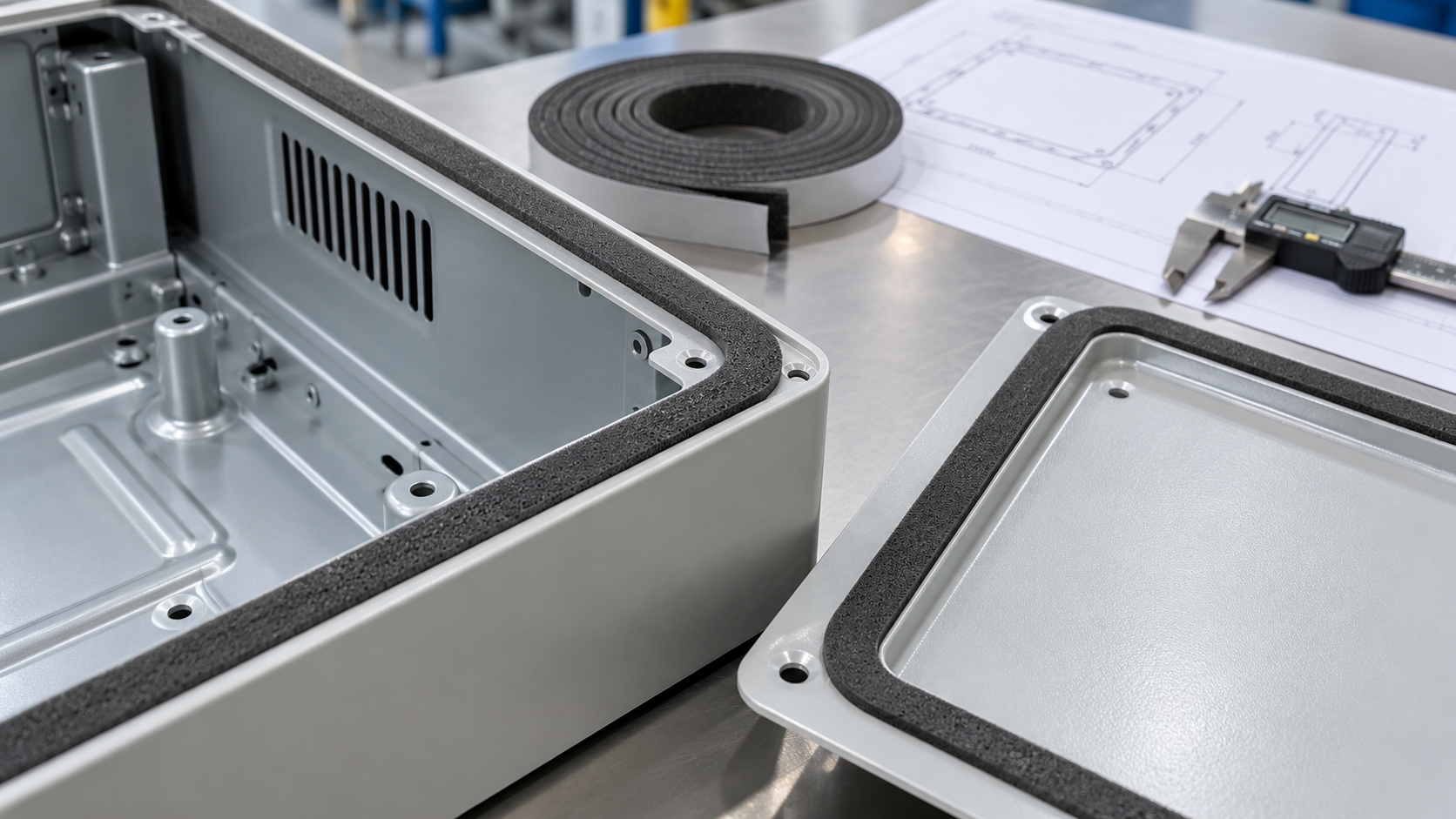
Déterminez si le ruban adhésif sert de joint d’étanchéité ou uniquement de cale d’espacement.
Guide de conception des joints d’étanchéité de Rogers makes the useful distinction: cell structure alone does not determine sealing. Compression, exposure and long-term relaxation matter. Thus, if the foam is merely placed between two panels without a controlled stop or fastener load, treat it as a cushion or dust barrier until leak testing proves more.
Draw the installed joint, not just the foam strip
Specify the maximum and minimum flange gap after tolerance stack-up. Compare those gaps with the proposed foam’s free thickness and its load-compression curve. The highest gap is the likely leak point; the smallest gap may over-compress the foam or deform a light panel. A closed-cell label does not replace a force-deflection curve for the grade being purchased.
For a die-cut frame, show the corner geometry and any breaks. For strip stock, specify whether joints overlap, butt or use a continuous perimeter. Adhesive bonds one face of the gasket to the panel; it does not seal an open butt joint by itself. Ask the supplier which side carries the liner and whether the strip can be positioned without stretching it around corners.
Test the actual enclosure under its real exposure
Make one trial at the loosest allowed gap and one at the tightest. Include assembled doors or covers after thermal cycling and any planned reopening. A water-spray or immersion result is meaningful only when its method, orientation, duration and pass criterion match the product requirement. Do not infer an IP rating from a foam datasheet alone.
The choice of adhesive is separate from the choice of foam. Confirm adhesion on the actual powder coat, plastic or glass after the plant’s cleaning process. Fiche technique 4496B de 3M describes a particular double-coated PE foam tape for mounting, gasketing and sealing, while also treating its values as grade-specific. Those values are useful as a reminder to request a grade-specific test report, not as specifications for LubandArt tape.
Calculate the compression window before choosing a grade
Define the installed gap from the assembled parts, not from a nominal CAD cross-section. One corner may be farther apart because a cover bows between fasteners; a screw boss may create a locally smaller gap. For a candidate foam, compare its uncompressed thickness with both extremes. Compression percentage is the thickness reduction divided by the original foam thickness. This calculation is only a geometry screen: the foam’s force at that compression and its recovery after aging still need grade-specific data. A drawing that says only “foam, 3 mm” omits the property that controls the seal.
The flange must be able to apply that compression without bending away from the gasket. A thin sheet-metal cover can appear flush near screws while lifting between them. If a hard stop determines the closing distance, include the stop height and tolerance in the stack-up. If installers control closure by torque instead, the fastener pattern and panel stiffness become part of the seal design. These are enclosure decisions; changing adhesive tack cannot repair a gap that never closes.
Separate leakage paths from adhesive failures
When a water test fails, record where water first appears before changing material. A wet corner or seam may indicate a discontinuous perimeter. A long wet span between fasteners points toward inadequate compression or panel bow. A strip that remains attached to the wrong side after opening suggests an adhesive or surface-preparation problem. A strip that stays attached but no longer rebounds suggests a foam-recovery problem. Each pattern calls for a different correction, so a single “stronger tape” trial can waste a cycle.
Use witness marks or photographs to document whether the foam contacted the mating flange continuously. Check whether the adhesive face was applied to a clean, dry production finish and whether the liner was removed without stretching the strip. If the assembly is reopened for service, include a second closure in the test plan. The first closure may flatten the foam, and a gasket that seals once may not recover enough for a repeat test. The number of allowed openings belongs in the purchase specification.
Define a pass criterion the supplier can reproduce
“Waterproof” is too broad for an RFQ. State the actual test standard or internal method, spray direction or immersion depth, exposure time, pressure differential if relevant, allowed leakage and the condition of the sample before testing. Specify whether the enclosure is new, thermally aged, vibrated or reopened. The supplier can then recommend a foam construction and submit a test report that addresses the same duty. If only splash protection is needed, say that instead of asking for a certification that the appliance does not require.
Record three outcomes for each trial: gasket compression at the limiting gap, adhesion to each production surface and leakage of the fully assembled enclosure. A material sample can pass peel testing while the enclosure leaks at a corner; an enclosure can pass a first water test while the adhesive later lifts during cycling. Keeping those outcomes separate makes the approval decision traceable and prevents a misleading single-pass claim.
Release a trial-ready specification
Send a joint drawing with flange material and finish, gap limits, fastening pattern, target ingress test and exposure conditions. Request free thickness, compression-force data, compression-set method, adhesive type and die-cut or roll delivery format for the proposed construction. If the joint must achieve a certified ingress rating or repeated opening cycles, keep the gasket approval contingent on assembled-part testing.
Questions fréquentes
Does closed-cell PE foam guarantee a waterproof joint?
No. The complete enclosure needs controlled compression and a test against its specified water-exposure method.
Can a PE foam strip replace a continuous die-cut gasket?
Only if the strip joints and corners pass the same assembled-part leak test; a butt joint is a separate risk.
Which thickness should be ordered?
Choose after measuring both gap extremes and reviewing grade-specific compression-force data; free thickness alone is insufficient.
Send flange drawing and gap limits, ingress test method and pass criterion, substrate finish and request a grade-specific sample and test plan.
Demander un devis · [email protected] · WhatsApp +86 180 6469 2463
Besoin de cette construction pour une série ?
Obtenir un devis